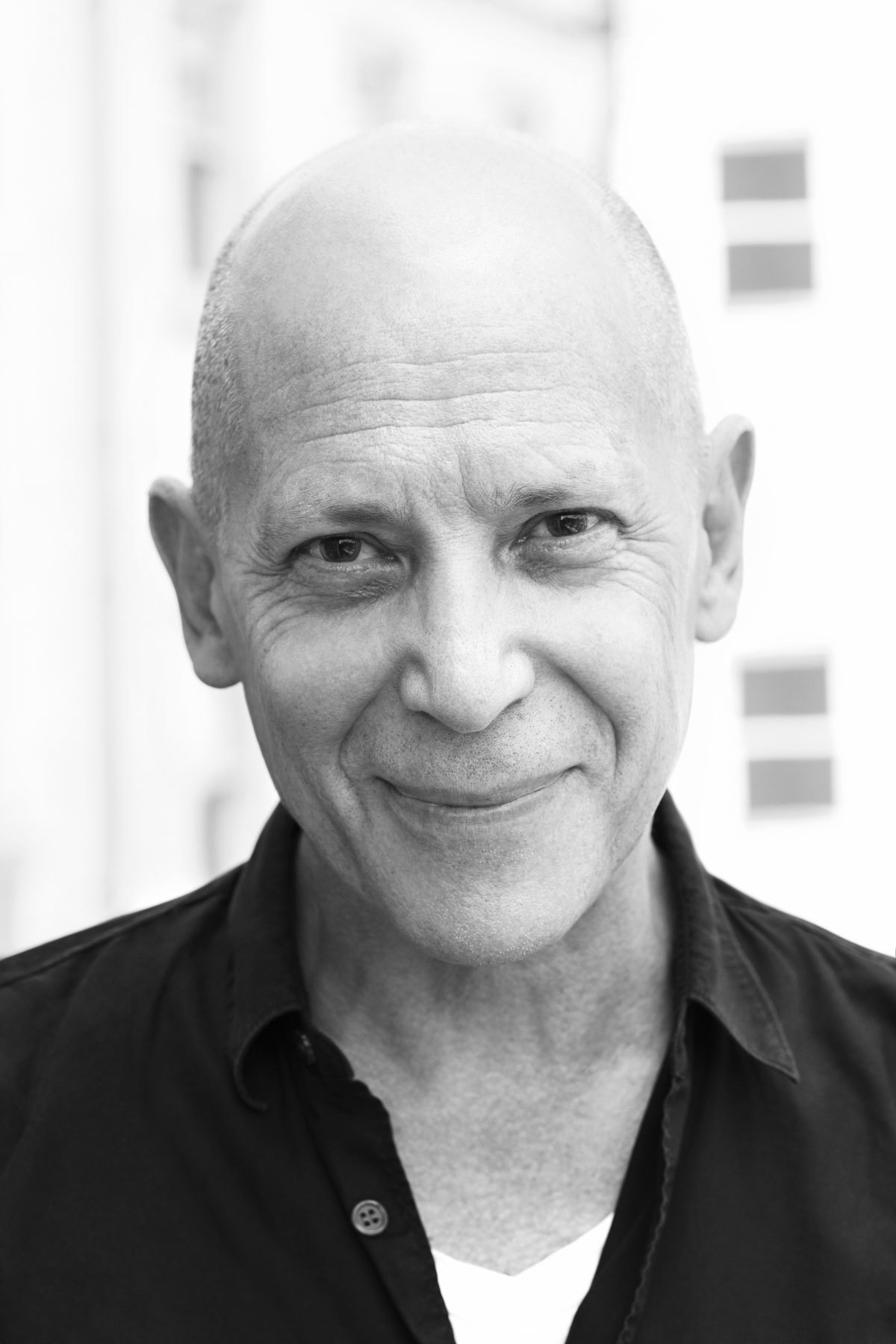
For all his expertise, Adrian Joffe says he doesn’t like to give advice. “What’s good for me is not necessarily good for you. It depends what you want.” But in the wake of a season where designers spoke out against the corporate pressures of the fashion industry, what Joffe has seems to be exactly what everyone wants. As president of Comme des Garçons since 1993 — the house founded and designed by his wife, Creative Director Rei Kawakubo — he has co-created an independent fashion and retail empire exemplary in an industry largely ruled by conglomerates. Like them, Comme des Garçons carries several designer brands under its soaring wings, which also encompass Dover Street Market’s four global mega-stores. But while it’s tempting to call it a mini-conglomerate in its own right, it’s this company’s independent spirit that makes it a role model to others in the current fashion climate. “That’s why Rei started it,” Joffe says of Kawakubo, who founded Comme des Garçons in 1969. “She wanted to be independent, and never have to answer or listen to anybody. Because we have such a strong idea of what we do and how we do it, it’s very hard to lose that independence.”
It’s a mindset evident in every aspect of his character. From the corner of a conference table at his Dover Street office, Joffe glances down at the notebook with interview scribbles he’s spotted across the table—never nervously, simply aware. Flanked by Dover Street Market Vice President Dickon Bowden, his quotes are persistently on point and he often wraps up his answers in a question mark. “What defines a good business?” Joffe asks, changing the subject to Dover Street Market, which first opened in 2004. “Sometimes Dickon and I tend to entertain compromises in terms of business, but basically we try to have the same values as Comme des Garçons: freedom, independence, no compromise, and stick to your vision. Whether right or wrong, it’s a vision,” he says in the composed articulation journalists typically like to ascribe to his Zen Buddhist practices. Add his shaven head and signature dark suit to the wisdom and Joffe, born in South Africa in 1953, certainly looks the part of a sensei. What is his verdict, then, on an industry rocked to its core last year by the departures of Raf Simons and Alber Elbaz from Dior and Lanvin, respectively? “People say there’s some crisis in fashion, but there’s not. Fashion is always changing—it goes with the wind: it comes, it doesn’t come… Or there’s a tsunami. Some of the big groups are waking up to the idea of taking risks. We are always taking risks—you have to! Opening Dover Street was a huge risk in the very beginning, and that decision of Kering to take Demna on is a great one,” Joffe continues, referring to the new Balenciaga designer, Demna Gvasalia, of Vetements fame. “It’s the same thing with Alessandro Michele. That was an incredibly brave decision: to take on an unknown? They were looking outside for a name, but they went with him, and bravo. Where is the crisis there? We’ve got a revolution at Gucci, and something very exciting going on at Balenciaga. A lot of the young designers are doing very well.” Outside, London cool kids are queuing up in front of Dover Street Market — which will relocate to Haymarket in March 2016 — hoping to get their hands on one of Gosha Rubchinskiy’s Greatest Hits pieces launching that day.
The Russian designer is one of the young brands Joffe has taken under his wing, but as he explains, Rubchinskiy’s arrangement with Comme des Garçons is as independent as Kawakubo’s house itself. Stocked in Dover Street Market early on, Rubchinskiy’s business went “pear-shaped” after two seasons. “I believed in him so much. So I said, let’s pay for his collection, let us produce it for him under Comme des Garçons Paris and distribute it,” Joffe explains, referring to the Paris division of the company, which also owns Dover Street Market. “I just manufacture his collections and pay him fees, royalties and stuff.” It’s the kind of liberal business deal Joffe can afford to make, like the fairy godfather he’s become to young designers in the industry, but which benefits his own company as much as it does Rubchinskiy’s—like when he decides to fly his Japanese buyers to London solely to attend the Craig Green show, or when he gives his store windows to Simone Rocha, both of whom Dover Street Market has supported from the beginning. “A lot of it is instinct,” Joffe says of the store. “We have a team. We don’t impose anything. It’s very democratic in a way, and often it’s quite arbitrary.”
If the corporate spinning wheel is marching at Comme des Garçons, it’s only to the beat of an independent drum. Under its umbrella, the company houses four eponymous designer brands: Junya Watanabe, Ganryu, Noir Kei Ninomiya, and Tao, who closed her label in 2011 but still designs Tricot Comme des Garçons. Contrary to industry habits, however, none of the brands were bought up by the company but instead founded and nurtured under it, along with their respective designers. “They have their own labels and are free to do their own collections, but we make it all and pay them a wage and give them the fabric and finance it and pay for their shows. That’s a way of growing a company,” Joffe says. “It’s like a family tree. It’s basically a creative business strategy to have these people. They’re free to go and come, but they really want to stay because it’s a nice setup for them. They learn. You don’t just come in and do a brand. They work hard. Junya was there for twelve years before he got his own brand.” In that sense, Comme des Garçons and its designers employ independence to retain the control needed to run a big-scale business, with creative freedom as the primary outcome for both parties. It’s anti-corporate corporatism at its best.
Which brings us back to the subject of advice. “It’s not teaching, it’s teaching by example,” Joffe says, talking about the company’s relationship with their designers. “We don’t like to proselytize, like those Christians who go to China and try to convert people. If you like the way we do it, then join in. Share.” This is what makes Comme des Garçons the envy of the industry in a time when designers such as John Galliano, Raf Simons, and Alber Elbaz have all voiced their concerns over a fashion system overworked and overloaded. Next to Giorgio Armani and Ralph Lauren (on a bigger scale) and Dries Van Noten and Rick Owens (on a smaller scale), Comme des Garçons stands out in its steady independent development and constant balance between creativity and business, and freedom and control. “With Rick and Dries and Rei and Armani, I think being your own boss is a very important thing,” Joffe says. And like Van Noten, Comme des Garçons doesn’t do pre-collections. “I think it’s a complete load of rubbish. You don’t need sixteen shows a year. I suppose it’s part of the business machine, but everyone I know is completely fed up with all of it. How can you have a show for a pre-collection, which is supposed to be just…” he pauses, frustrated. “Let them get on with it. We’re never doing pre-collections.”
Joffe does like the early deliveries from a Dover Street Market point of view—if only it would all be part of the same collection. “But we’ve always pushed that. We have new things coming in March, April and May and people are used to that. They say, ‘What’s new today?’ It’s always new and that’s what makes the retail experience more interesting.” He’s less enthused, however, about the increasing tendency of brands to not put their runway pieces into production for stores and their costumers to buy—a stark contrast to Comme des Garçons, which produces 95 percent of its collection on average, no matter how avant-garde. “It happens so often in these showrooms that we try to buy these things and they’re not produced,” Bowden says. “We’re the only shop in the world that wants to buy these really strong things, but often we can’t. It’s quite saddening that the creation doesn’t…” he pauses. “Reach its final destination,” Joffe concludes. “It’s a vicious circle. It’s going to crash. This thing where they won’t produce it even though we might buy one or two or three, so then they’ve got to do something else to fill that gap—how can that be sustainable? A part of the fashion industry’s so-called crisis is this never-ending mouse on a wheel,” Joffe says. “Luckily I’m not on that.”
If he’s not, it’s because the infrastructure of Comme des Garçons is entirely designed to stay focused on what mattered in the first place. Expansion only happens if it represents another way of expressing Kawakubo’s values, such as when she agreed to do fragrances 21 years ago. “We never wanted to own our factories or own all our shops. We do a lot of wholesale,” Joffe explains. “We don’t source crocodiles or farm sheep or buy factories. Dover Street was a part of the creation and development of the company. Retail strategy can be creative.” And when it comes to the company’s more commercial diffusion lines — which they never call them — the philosophy is intact. “Within each brand of Comme des Garçons, the way so-called compromises are achieved is having brands whose very essence is compromise,” he notes. “Comme Comme, for instance, is about style: what you wear. That’s necessarily something that’s more compromising than the very uncompromising main collection, which is just pure creation. The very idea of Play is a designed brand that has no design, but we don’t think of it as a compromise, because it’s a very strong concept.”
Not one for pandering, Kawakubo rarely does interviews and only entertains a select number of invited journalists to a few cryptic words backstage at shows, effectively avoiding the pressure of the industry’s media. (It’s an approach Martin Margiela would brand in the late 1980s, which John Galliano now gets to enjoy in his place. “The way he’s keeping back, that’s him, too,” Joffe says of Galliano, whose collections he’s so thrilled with he goes to the Maison Margiela showroom to place the Dover Street Market order himself. “He went through something quite difficult, but it seemed to be that nobody learned much from that, did they?”) If Kawakubo feels a pressure from fashion it’s first and foremost on her own account. “The standard she gives herself makes her time very difficult. To think of something new every time, it’s very hard. The more new things you do the harder it is to do something even more new,” Joffe says. He tells her, “‘Maybe the next one doesn’t have to be so earth-shattering, maybe you don’t have to reinvent the wheel every six months?’ But she says, ‘No, I can’t get out of it. That’s what I’ve got to do.'”
Credits
Text Anders Christian Madsen
Photography Thomas Lohr