
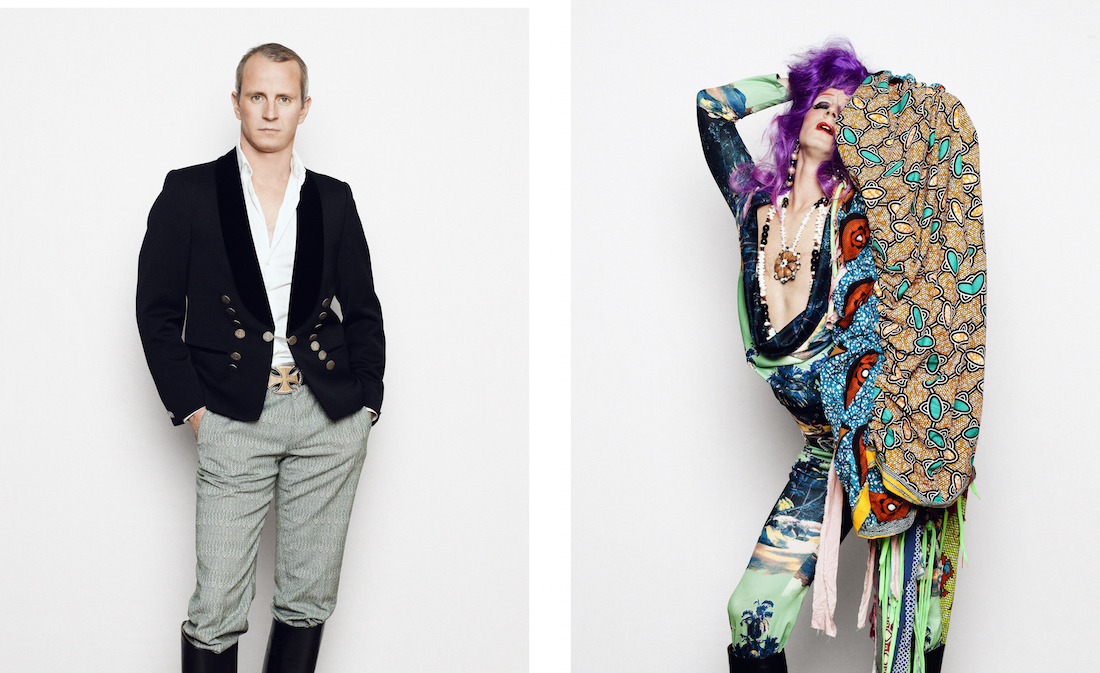
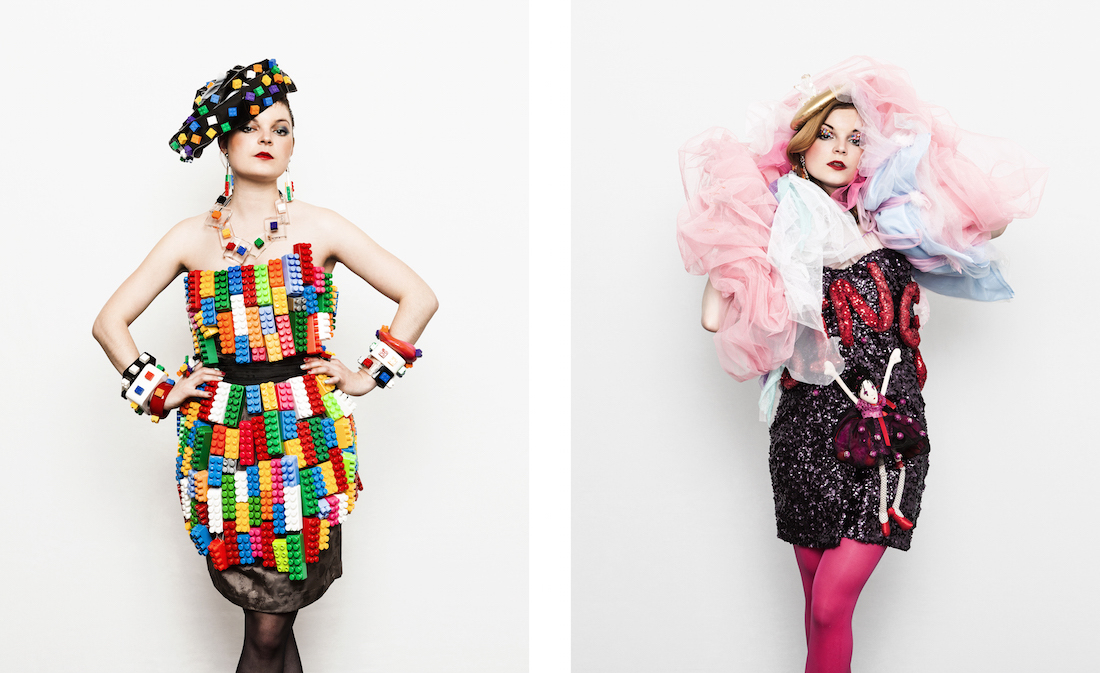
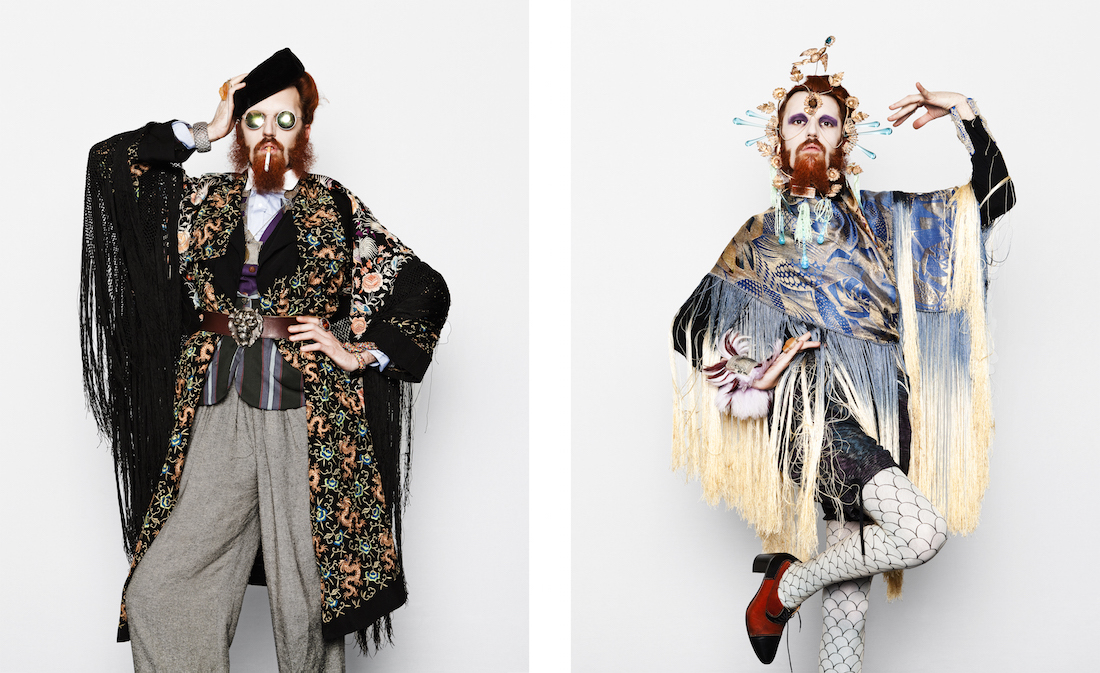
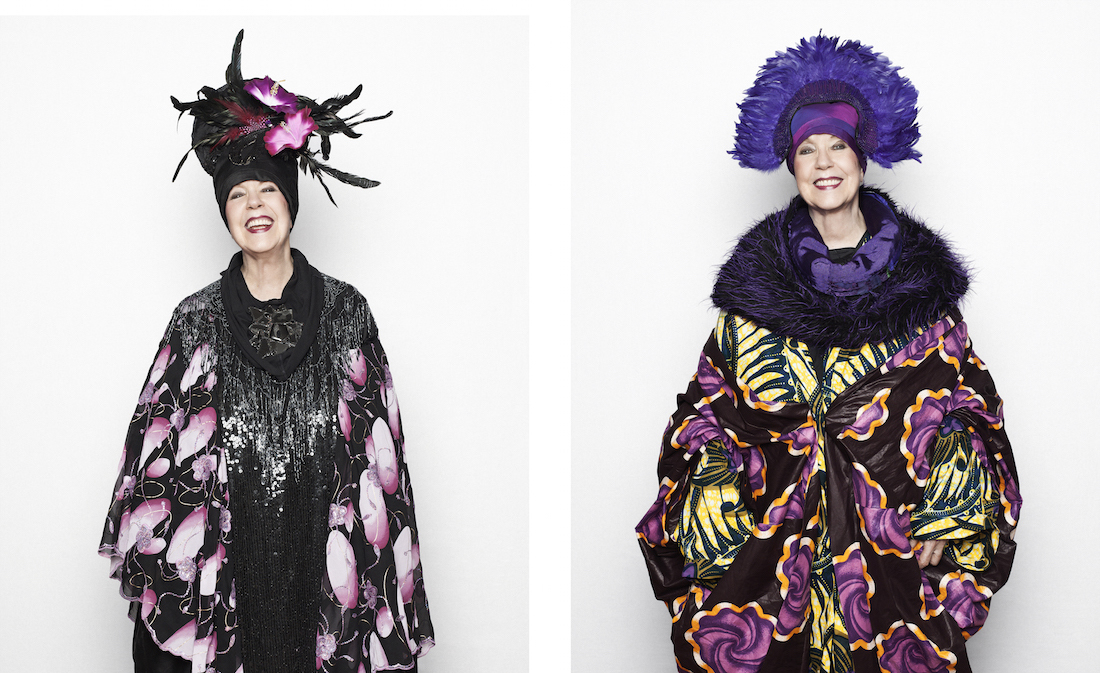
British photographer Anthony Lycett loves portraiture. He has focused on older women with beautifully silvered hair and the fiery allure of the ginger beard. His longest-standing series addresses style versatility: poise and panache, flamboyance and performance. He’s been nourishing the series “Self-Styled” for seven years — the most recent portrait session is from December 2015 — using diptychs featuring day and night outfits. The works are currently on view at the Parisian Galerie Isabelle Gounod.
Peppered with avant-garde looks that challenge any beige conceptualization of getting dressed, the peacocking personalities externalize their creativity with face jewelry, oversized bows, lavish kimonos, rhinestone eyeshadow, Lego dresses, Iris Apfel bangles, Medieval puffed sleeves. The array of images (and a video slideshow) introduces colorful characters that will likely inspire viewers to smarten up their own looks. Lycett discusses his allergy to fashion blogs, the mythology of Parisian chic, and his endless fascination with confident personal style.
How did you get into photography?
Initially, I had no background at all. I come from a family where the standard family pictures have heads cropped off and the flash is too bright. When we’d process film in a shop, they’d put a sticker on saying “badly exposed” or “needed flash.” But funnily enough, when I started to study it, I felt very comfortable within the medium.
You began “Self-Styled” in 2008. What made you start?
I used to shoot more fashion, and we’d always look for character models. These people would turn up and they’d look so amazing. I wanted to find out more about them. We’d dress them up in the labels that the magazine needed for advertising, and it diluted them.
I wanted to look at people. Portraiture has always been my main interest. I started to photograph a few friends, and a few of their friends. Seven years plus on, I’m still doing this. There are always more people — especially in London. It’s perpetually in a state of flux; always with very creative energy about. It’s about trying to capture what gave people their confidence to be this way
And “Self-Styled” is ongoing?
It could go on forever — and that could just be London. There are cities that I’d love to get to, like New York, which would just be another world. I know I could find a similar energy. I find this less so in Paris. It’s very conservative compared to London.
So true: Paris has this style-saturated reputation from its fashion history, but the reality is much more sedate.
Exactly, you think of the history, this city of très chic style — I wanted to come and find that. It’s really hard. On the streets of London, if you go around, you’ll find wonderfully-dressed people everywhere. Whereas in Paris, you have to dig around in the bars at night; they don’t come out in the daylight. There’s more aggression towards alternative lifestyles. Because of the diversity in London, it’s more accepted for people to be different because they come from every corner of the world. You can have blue hair, you can have pink hair; no one’s really going to look at you. In Paris, people are very negative to anyone that’s different. I don’t think the French like change.
It was interesting to see the response of the French who saw the exhibit. As much as you get the sense of conservatism, and people being very “grey” all the time, it felt like “we wouldn’t say ‘no’ if we saw people like this, but we don’t see enough of it.” They think it’s an English thing, rightly or wrongly classified as eccentricity. I don’t think you have to be eccentric to have blue hair. And I think if more people see this freedom to express themselves, more people will do it.
How well do you know the people you photograph? Is a personal connection important or helpful?
Not really. With people I’ve met on the day, you just learn from that initial meeting. If they’re more expressive, or if they’re quieter — I can only capture what they offer me. It’s hard to place someone in front of a white environment and say: now be natural. I’m intrigued by people in their spaces in their comfort zones, where they have what they need in their studios. But “Self-Styled” is purely trying to concentrate the viewer on the character, the details.
The conversation afterwards is the most important thing. We work together to choose the images, as opposed to them going away and me making the selection. We go through the shots, and we talk about the relationship between the day/night outfits.
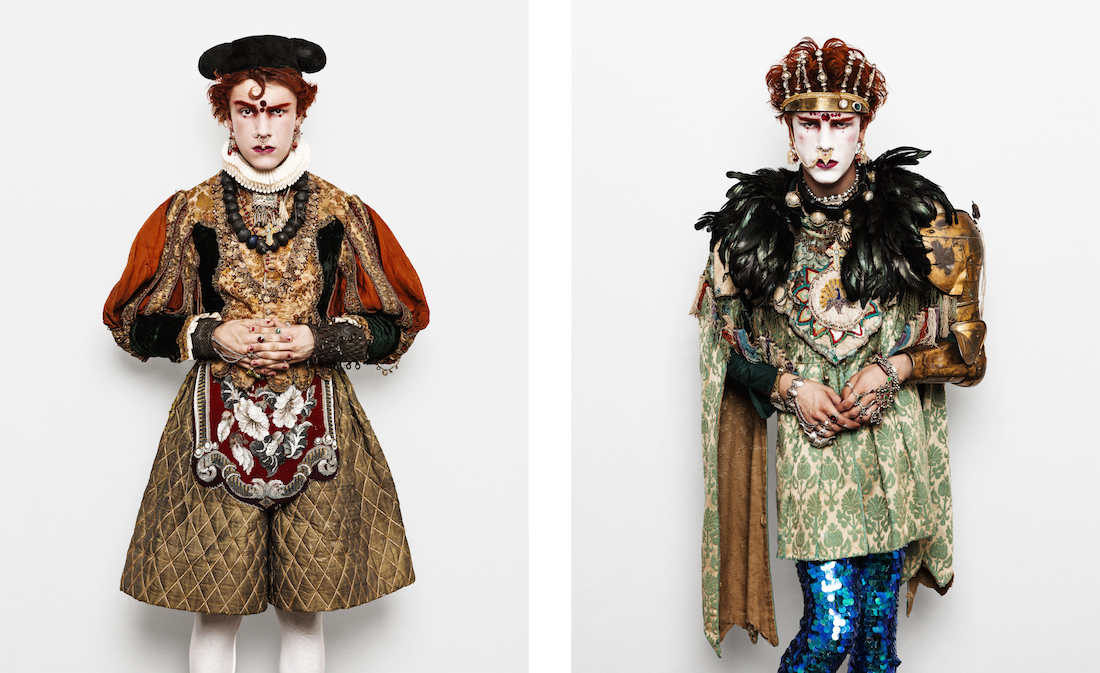
It was interesting that you cited professions with the photos. There were the “likely” professions who dressed interestingly — DJ, costume designer, performer, artist — but also the occasional accountant, lawyer, doctor. How much do you find profession influences a look?
I do love when I find that [unexpected] juxtaposition. It’s harder to find these people, but when you do, you don’t expect them to have the same spirit as someone who’s a stylist or fashion student. You don’t have to be a performer to have your own voice.
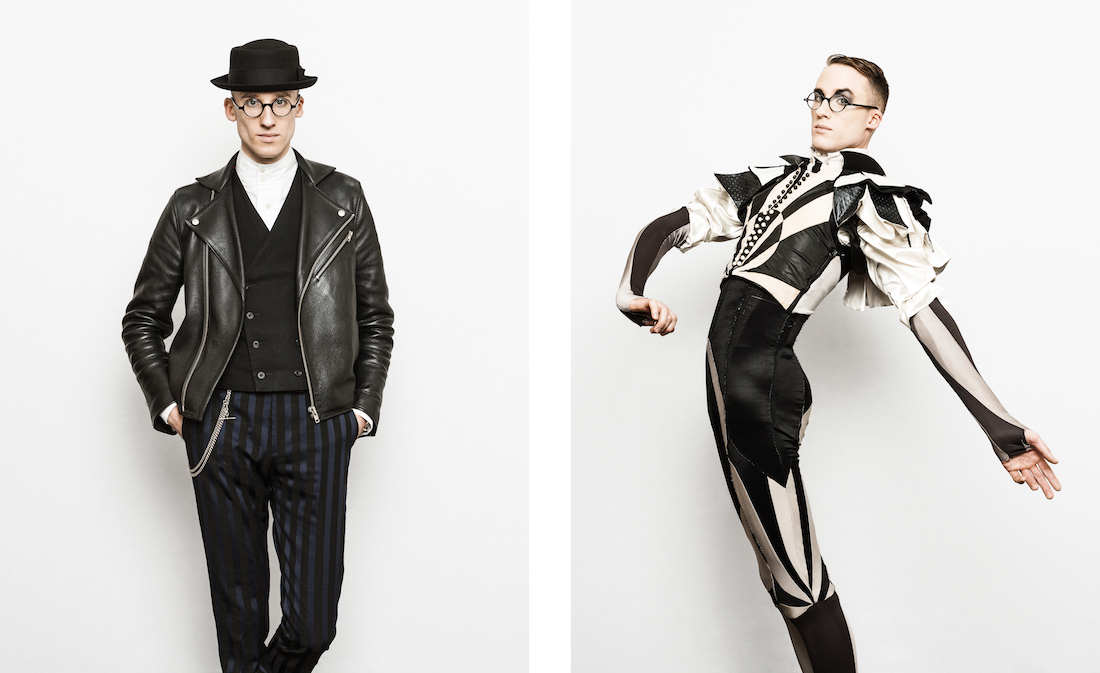
Street style blogs have changed the way people perceive style — or at least made people more self-conscious about it. Do style blogs have any bearing on your work?
I never actually look at style blogs. I don’t want people to class this as a fashion series. I look at the subjects as a collective tribe. I specifically crop the photos and almost never show full length, so it’s less about the fashion; I’m more focused on the characters, and how they dress is almost secondary. There are plenty of people who examine fashion in that respect, and there are thousands of style blogs that have no soul. They’re just looking at what is on the surface, and that’s not of interest to me.
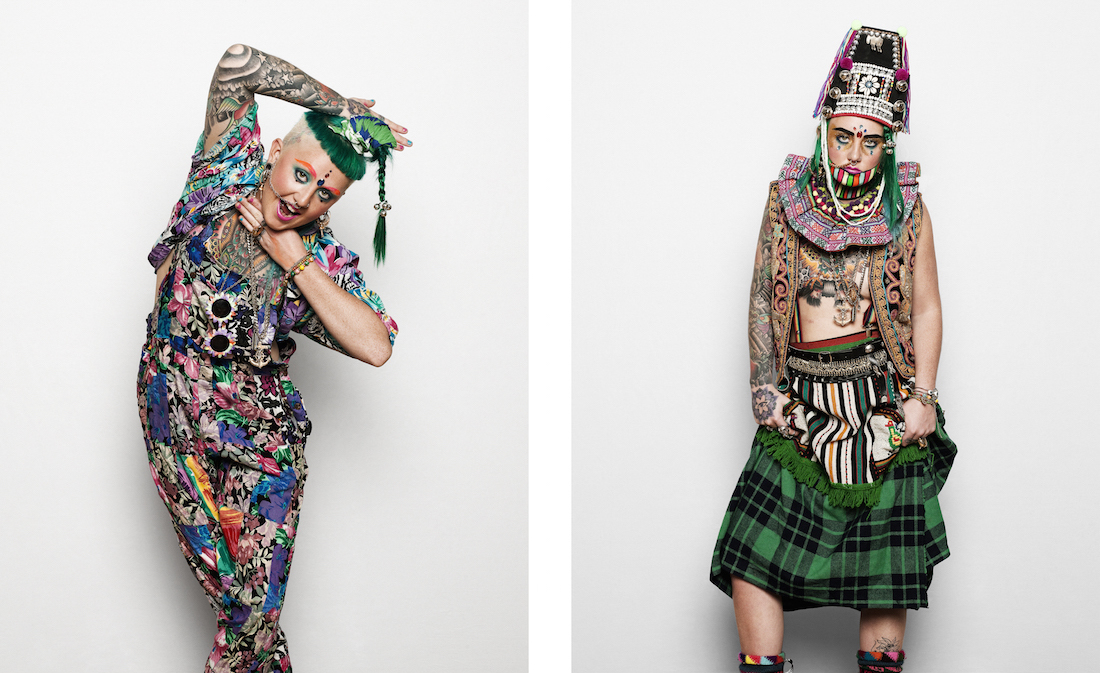
Who is influential to you?
This project was influenced by Richard Avedon’s portraits of people in the American West, the ones that people don’t want to talk about or recognize: your drifters, your drug addicts, your mental health patients. Avedon’s approach was very much about the character of the person, unlike the celebrities, politicians, famous people he photographed. He made very dynamic portraits very simply, just white backgrounds, using natural daylight. Unfortunately, I’m living in the wrong country for daylight.
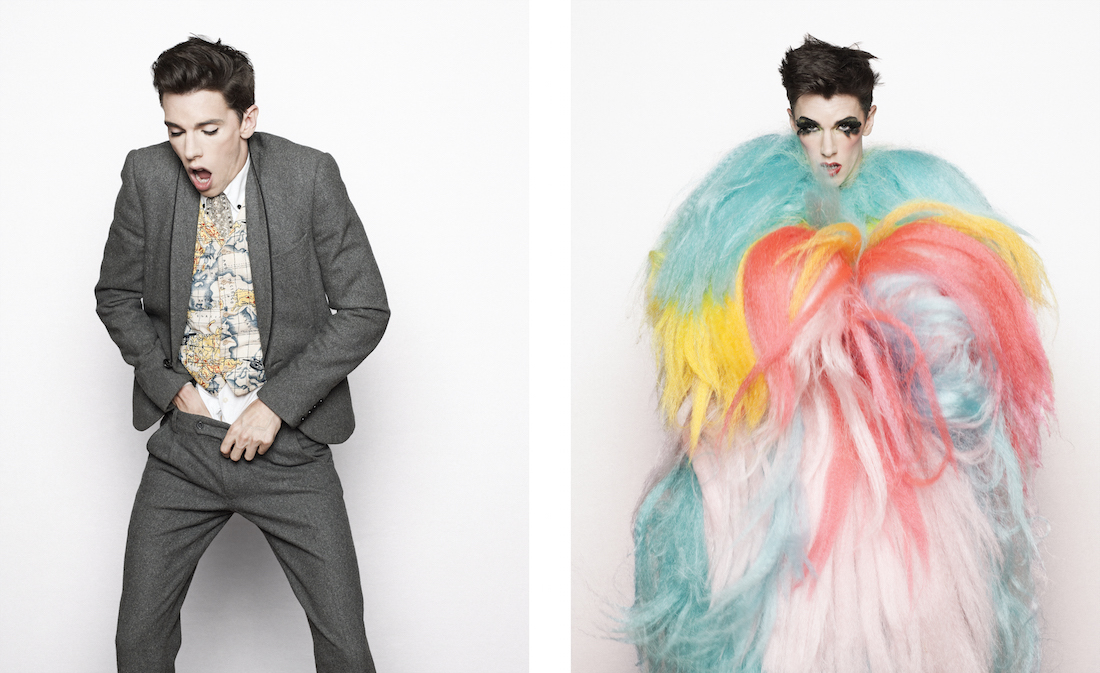
Credits
Text Sarah Moroz
Photography Anthony Lycett