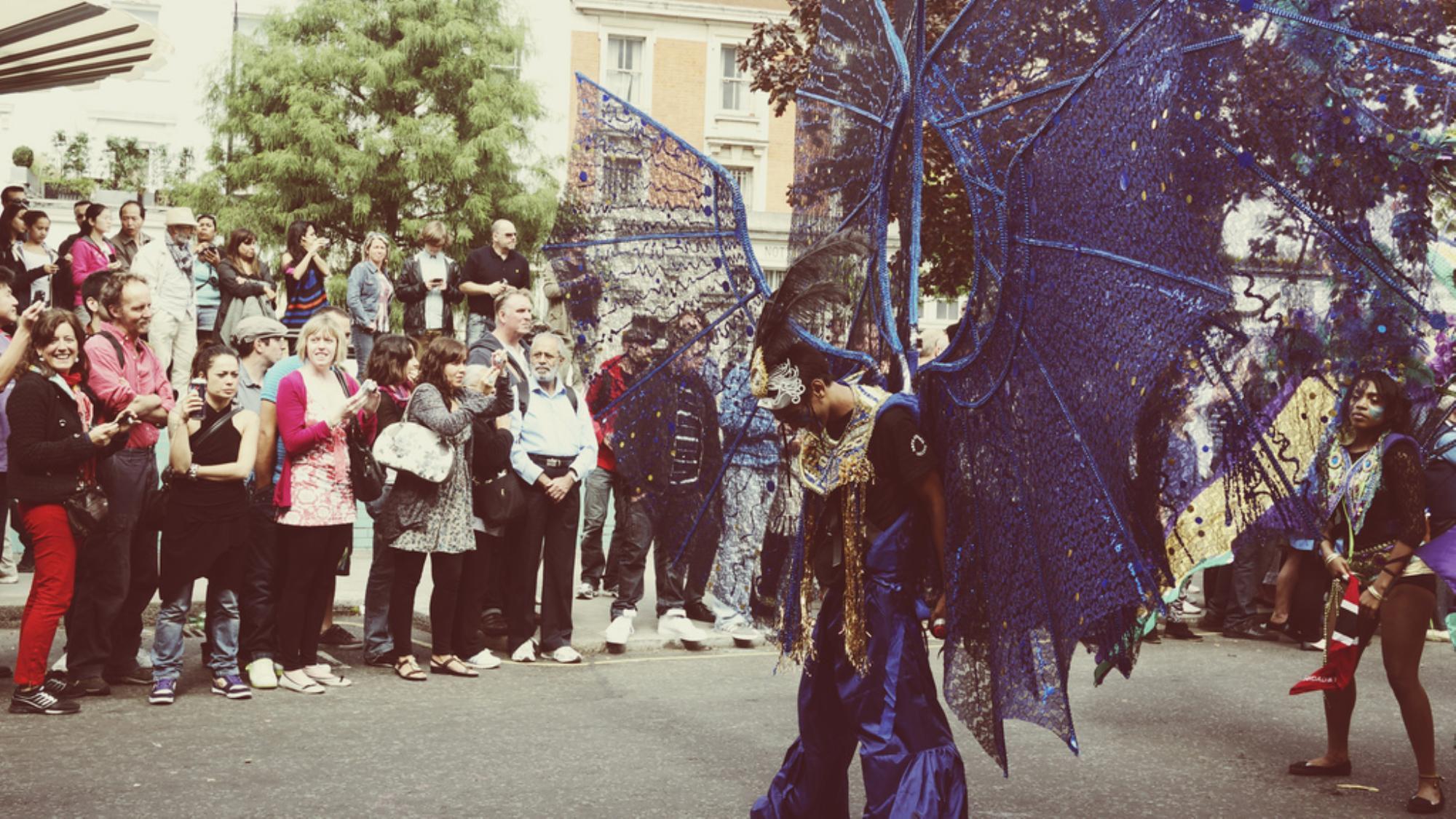
Baroness Victoria Borwick- scion of the ancient Poore Baronetage family, wife of 5th Baron Borwick, and Tory MP for Kensington- has decided that, really Notting Hill Carnival is just beastly, and something must be done.
“They don’t really want to see any changes but we’ve got to be realistic, this is not the Carnival we had ten or even five years ago,” sighed the Baroness in last week’s Evening Standard.
“We want it to be a fun family occasion, celebrating the music and the culture, not somewhere people tell terrible stories about crime.”
This is an interesting statement from the Baroness, and one she uses to justify her decision to send out a survey to residents of Kensington and Chelsea suggesting that Notting Hill Carnival becomes a ticketed event to ‘improve on safety’. It’s an interesting statement because the only reason the majority of people would (or justifiably could) “tell terrible stories about crime” after spending the day at Europe’s largest, greatest street festival is because – statistically- they like to talk total shit.
Since it first started, media coverage of Carnival has been framed through a lens of ‘how much trouble was there?’ The idea has been repeated ad infinitum; Notting Hill Carnival is a place where bad things happen. In post-Carnival TV and newspaper coverage, crime and disorder are placed front and centre, usually referred to before anything else. Curiously the crime rate is never bought up in any manner other than how it relates to previous crime rates at Carnival. So, for example, the current statistic that the Evening Standard is wheeling out to demonstrate what a battlefield Notting Hill descends into over August bank holiday is that there were 10% more arrests at Carnival 2015 than there were at Carnival 2014. 10%? Well that sounds worrying, doesn’t it? But as is usually the case when people are using stats to justify an agenda, it’s a bogus piece of misdirection. Rather than looking at how Carnival’s crime rate relates to itself, it would be more realistic to see how Carnival relates to other places and events. Is it really a place full of ‘terrible stories about crime’? Reading the Baroness’s comments you’d expect the Carnival crime rate to be far, far higher than your average High Street on a Saturday night, wouldn’t you? And if it is, then what does that mean for places with comparable crime rates? Are they terrible too?
Crime rate in the UK is worked out with a simple formula; you take the population of an area, divide that population by 1000, and then divide the number of crimes committed by that figure. So Notting Hill Carnival has a population of 1,000,000. Divide that by 1,000, and your left with 1000. OK. So this year there were 407 arrests at Carnival for offences ranging from the serious; violent offences such as stabbings, to the petty (and these are the majority), things like hoofing laughing gas or smoking a spliff – something the Baroness’ boss David Cameron was once keen on himself. 407 divided by 1000 gives us the crime rate of Notting Hill Carnival, the amount of crimes committed per 1000 people. That figure is 0.407. That is the figure that justifies Carnival’s constant, long-standing demonisation as a hotbed of crime and anarchy. That figure is fuck all.
Chipping Norton, home to the aforementioned David Cameron, as well as several media figures who have had a splendid time publishing stories of violence at Carnival has a crime rate of 3.66. That’s 8 times higher- and it’s not just for public order offences, a fair percentage of that 3.66 is accounted for by violent crimes. So here is the bald fact: you are 8 times more likely to be the victim of crime wandering the smugly bucolic wonderland of Chipping Norton than you are following a soca rig at Carnival. Logically this means one of two things; a) crime at Carnival is being grossly misrepresented, or b) we need to send the troops in to Chipping Norton – the place is in the grip of a crime wave.
As far as I’m aware, Chipping Norton isn’t actually an apocalyptic cross between Gotham City and Country File, which mean s we’re looking at option a. Talk of Notting Hill being a place full of ‘terrible stories’ is a basic lie, leaving other, as yet unanswered questions; why does the Baroness think Notting Hill is full of crime? Why does she really want to make Carnival ticketed? Doing such a thing will undoubtedly signal the slow death of one of our capital’s greatest jewels, reducing it to a sham of £5 whistles and staged dancing coppers. Why does this attempt to force wider legislative control – from calls to move Carnival to Hyde Park, to this current attempt to monetise proceedings via ticketing, come up year in year out?
We can only speculate. Constant, racist dialogues have demonised Carnival since its inception. Those regular canards of psychotic ‘gang members’ and ‘thugs’ are barely masked euphemisms for young black men. It’s hard not to place the ‘terrible stories’ quote – entirely unsupported by facts as it is – inside this context. There is an unpleasant dog whistle narrative lurking away in the reports of trouble at Carnival, a nasty implication that any collection of black people, no matter the size, is automatically criminal in nature. It’s certainly a theory the police subscribe to, as they themselves admit. England has never been able to face up to its colonial past (apparently we need to stop apologising for it – although no one seems able to pinpoint when we ever started), but only the most historically belligerent or illiterate would argue that this past doesn’t inform the fear and mistrust directed at Carnival. If the Baroness really wanted to hear some ‘terrible stories’ her time would be better spent perusing the actions of the English in the colonial Caribbean – after all, Jamaica was still a colony in her lifetime.
Alongside this racially motivated fear, Carnival’s very nature, it’s joyous, amorphous, organic, chaotic and evolving existence is directly at odds with the spirit of cold hard avarice that has dominated London in recent years. Houses are no longer homes in communities – they are bought by the wealthy and left empty as investments. Squatting residential properties has been criminalised to further facilitate this – in the mid-60s when Carnival started, Notting Hill was alive with squats full of artists, immigrants and dreamers; some of Britain’s most iconic cultural exports, from punk to lovers rock to the mini skirt were formed in the area. Now the city is more concerned with bulking out portfolios than being seen as a cultural capital of the world. Who needs a street party? Certainly not the well-heeled residents that have been forcing property prices in West London to hit insane levels. Certainly not the investors who snapped up the borough’s council properties in Margaret Thatcher’s right-to-buy gold rush of the ’80s. 40% of former council properties in Chelsea and Kensington are now owned by private, non-resident landlords. The heart of the borough has been hollowed out by grubby investors scoring cultural capital off its reputation for ‘vibrancy’, but with no appetite to have any of that actual ‘vibrancy’ having fun on its doorstep. If the Baroness has her way, if Notting Hill Carnival is reduced, against the wishes of organisers, into a pale, ticketed parade, then the whole city suffers; another step on our rush to become the whited sepulchre of Conrad’s imagination.
Credits
Photography Eli Epstein