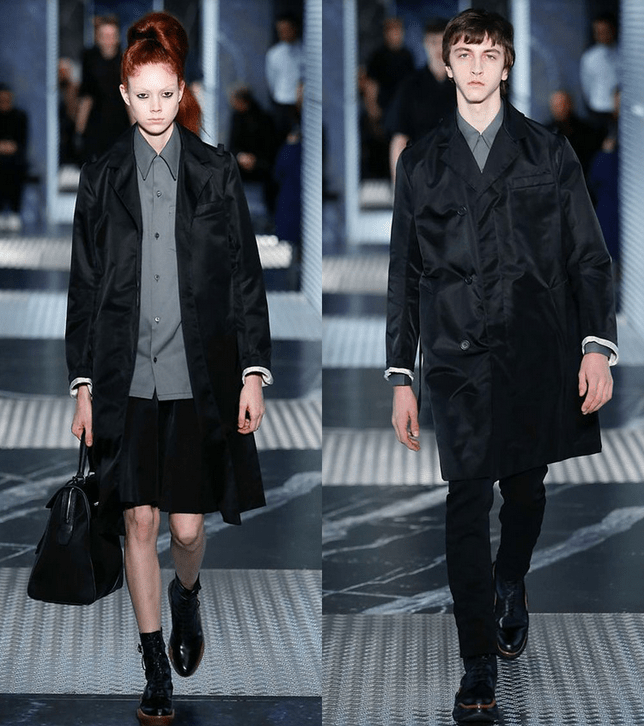
This Fall/Winter men’s season brought with it a new wave of conversations around gender and androgyny in fashion. And like so many interesting and beguiling things, it was kickstarted by Miuccia Prada. For their Milan show at The Infinite Palace Prada chose to show both Fall menswear and Pre-Fall womenswear, Miuccia explained on Instagram that “the show was an exploration of the relationship between men and women.”
Her sentiments were continued in the manifesto on each seat: “Gender is a context and context is often gendered,” and was reflected back in the designs themselves. The men wore Manchester inspired mod looks with double breasted nylon jackets and slim pants. The women mirrored them in a palette of British sky greys, with boyish forms and masculine shapes. It was an exploration of androgyny sure, but in the way we’re so used to seeing, the female absorbing the male.
Much is spoken about the breakdown of gender in fashion, whether its a YSL smoking jacket or the irrepressible normcore movement complete with its token boyfriend jeans. But as the Prada show demonstrates, obviously in an eternally eloquent way, we’re stuck seeing gender breakdowns as a one way street. Why wouldn’t we freely celebrate the absorption of men’s aesthetics into womenswear? It has after all proven again and again to be a success, and with women like Tilda Swinton and Jenny Shimizu making it look so good you could hardly fault the trend.
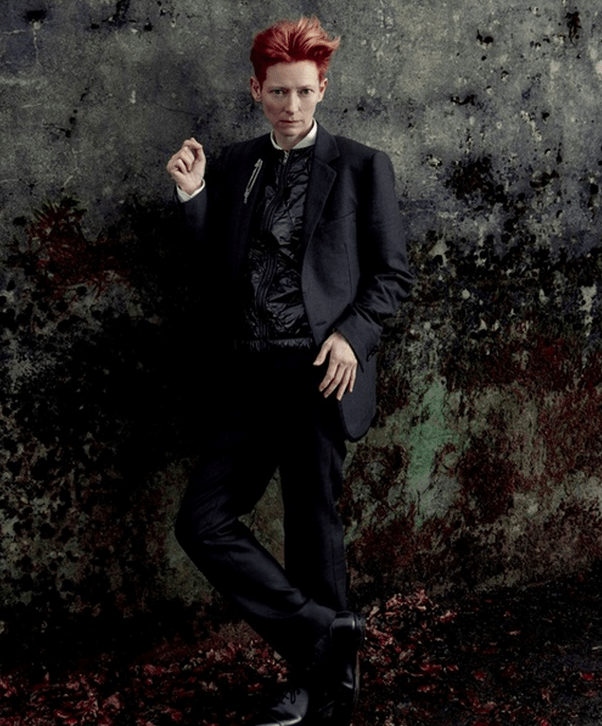
But we stop short of folding the woman’s aesthetic into the mens and continually fail to examine why we’re so comfortable to appropriate the masculine, while the feminine is deplored in any form other than what is instantly familiar.
Sure, we can’t be too hard on ourselves, it’s hardly a trend that exists only in fashion. You only need to look at how we speak to see our distrust for the feminine—pussy, bitch, throw like a girl—we’re conditioned to avoid these things. Call a man a sissy and he’ll take it as an affront to his strength and virility. Call a woman a tomboy and she’ll appreciate the compliment of as carefree and down to earth.
When we do see men dress like women, or at least adopt some aesthetic quality, it’s usually cartoonish. Dennis Rodman in a wedding dress, Liberace dressed up as Marie Antoinette. It’s hardly Marlene Dietrich in a tuxedo.
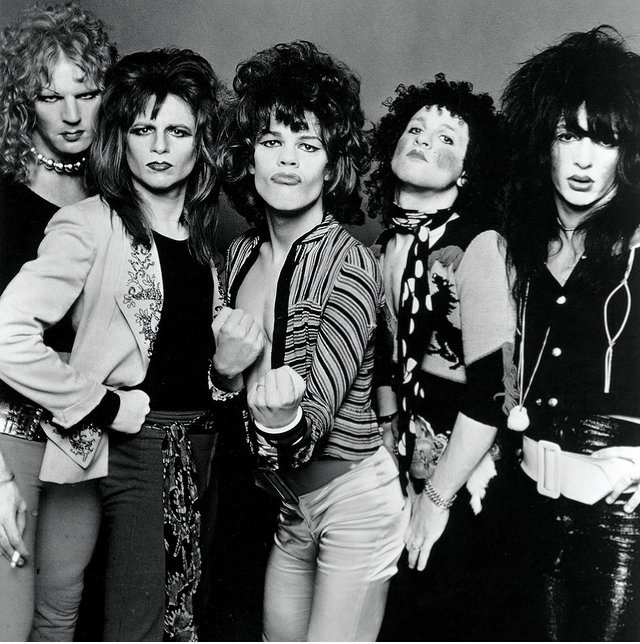
To be fair there are exceptions, but unusually they seem more confined to the past. 18th century dandies wore makeup and corsets without shame, they saw beauty and wanted to celebrate and engage with it. Punks like the New York Dolls wore lipstick and blouses, they didn’t give a shit about any established norms, sexes included. David Bowie seemed to created his own third gender with Ziggy Stardust. During grunge Marc Jacobs and Kurt Cobain wore skirts but could never be accused of being sissies. These figures were strong, anti-authoritarian, and often highly sexualised by the women who appreciated the change.
But despite it looking like we might have an even-gender breakthrough entering the mainstream it disappeared by the new millennium. Looking at Bowie you can hardly imagine his super star contemporaries ever considering doing the same. Kanye loves fashion, but not enough to put on a dress.
Although the trend has dried up, it hasn’t evaporated, and present day heroes inverting the norm shouldn’t be ignored. Andreja Pejic’s whole career is a testament to the fashion industries ability to see sex as fluid. Even Conchita’s stint as Jean Paul Gaultier’s bride deserves a mention. As does Craig Green’s exploration of romanticism and masculinity with tunics and skirts in his Fall/Winter 14 collection, both were met with wide acclaim.
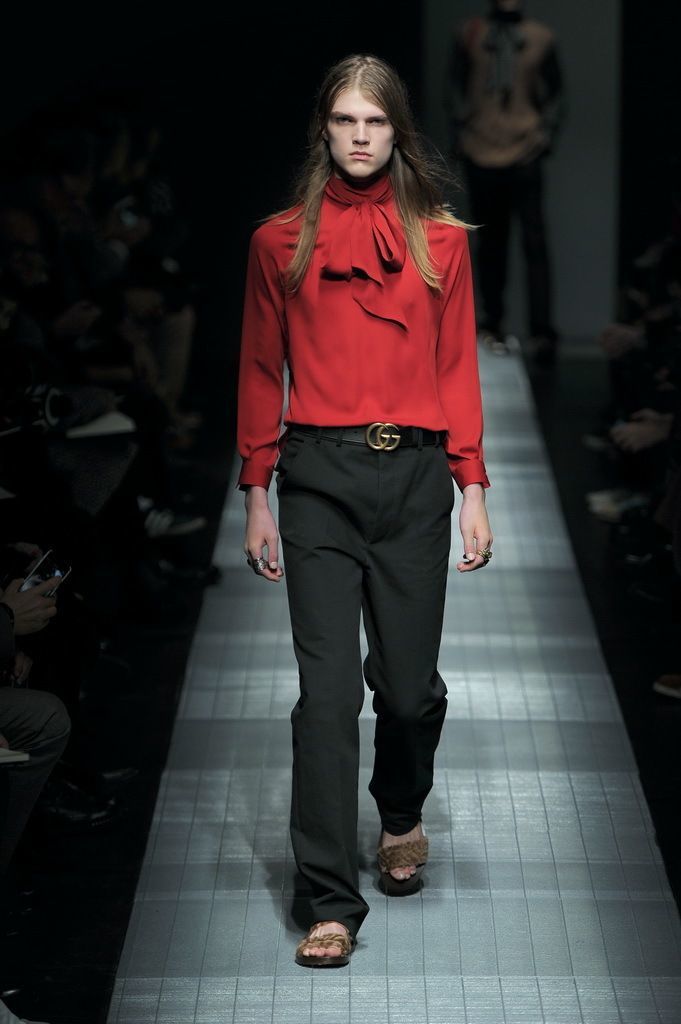
Gucci’s recent Milan show, perfectly named “Urban Romanticism”, was a study in eloquent appropriation as they incorporated bows and delicate scarves into their recent menswear. The house continues its exploration of 70s romance and sexuality, referencing the decade’s frequent aforementioned rejection of gender stereotypes. But bookending last week, Rick Owens marked himself as perhaps the brightest light in the quest to bring the feminine into our perception of androgyny with his recent Paris show. Not only did he send skirts and cloaks down the runway, but full frontal, totally desexualised male nudity too. Although it did result in an expectant shock wave, it also addressed the fact that female nudity in high fashion is okay, but penises were until this week off limits.
Despite the laments, 2015 has started with conversations about exploring and deconstructing gender. And led by the intelligent voices of Prada, Gucci, and Rick Owens you couldn’t ask for better MCs on the issue. But we hope it doesn’t stall as a note on a seat, or a PR ripple, but rather permeates the industry and the minds and wardrobes of those who dwell in it.
Credits
Text Wendy Syfret
Image Prada FW15