
This contains surface-level spoilers for Blue Film.
Before it secured its world premiere slot at this year’s Edinburgh International Film Festival, I had heard whispers about—and seen stills of—Elliot Tuttle’s Blue Film. There were rumors around what it was really about, and that many festival programmers had seen and rejected it for tackling such fraught moral terrain—the kind of hearsay usually reserved for gore-heavy horror movies.
I can’t say I’m surprised now that I’ve seen it. Sure, Blue Film isn’t a horror, but its central premise is terrifying in its own way. Much in the same way we’re expected to avoid all spoilers when it comes to scary movies, there’s a temptation to do the same with this. But to do so would trivialize its tricky—and very real—subject matter.
It opens on the pixelated screen of a webcam livestream. A hench, tattooed LA sex worker with the stage name Aaron Eagle (an excellent Kieron Moore, who appeared in i-D in the past) flexes for the camera, demanding financial submission from his captive audience. In the comments, adoring fans message heart-eyed emojis and dollar signs as he shows them more flesh, spitting out more coarse, explicit language. The money rolls in.
“It’s chilling, frequently repulsive, and provocative”
Aaron is so transfixed with power that he unveils his plans for the night: a meeting with a man who’s paying him $50,000 for a night in his company. He thinks he knows what to expect—a regular encounter with a submissive man who lusts after his body. But he doesn’t yet know who this man is.
Soon after arriving at a facsimile LA suburban home, he finds out. His name is Hank (the esteemed American character actor Reed Birney), he’s from Maine, and he knew Aaron—whose real name is Alex—in his past life. Hank, it turns out, was Alex’s high school English teacher. But Hank had been fired and sent to prison for attempting to sexually assault one of his students. He’s handed over $50,000 for one reason: to reunite with Alex, who he was in love with as a teenager and has thought about ever since.
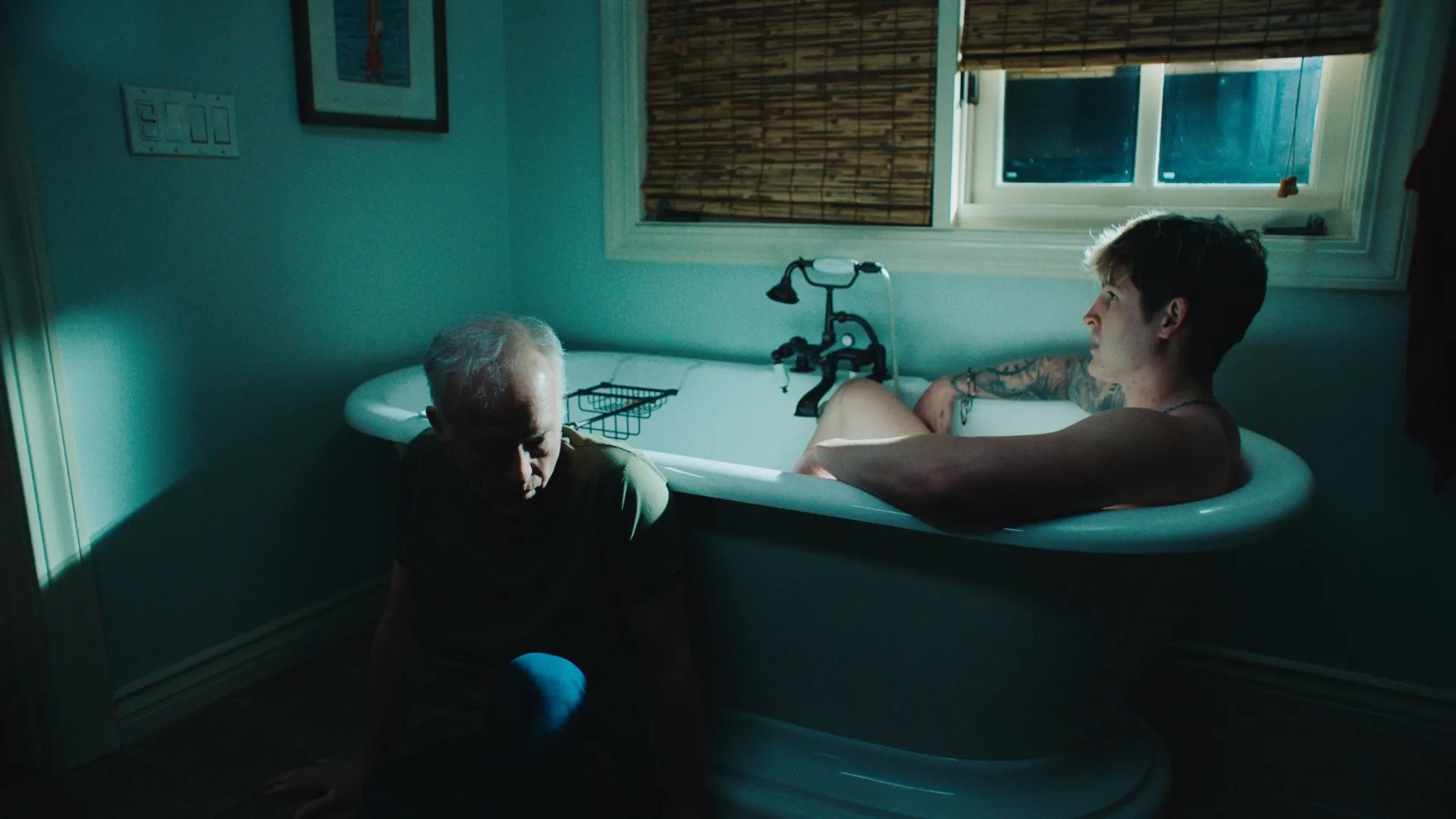
Despite its title (an allusion to pornography), Blue Film is largely a long, discomforting conversation between these two men as they hash out their pasts and try to piece together how each ended up where he is. While Hank was once a civilized professional, he now bags groceries for a living. Alex, an interesting, complicated teenager, has wound up making money through financial domination—bullying submissive people into handing over their life savings so he can spend them instead.
The issue of morality is always lingering in the air, as is power. When Hank spends $50,000 to be in Alex’s company, is he under Aaron Eagle’s famously harsh bootheel, or is he financially binding Alex into the submission he long fantasized about?
Hank is objectively a monster, but the film dares to question whether all monsters like him look and act the same. The idea of a pedophile and his now-grown target conversing and even laughing together seems improbable, because we’re taught that people capable of committing heinous crimes are easy to spot. This didactic way of showing evil in film is one that Blue Film doesn’t subscribe to—and for a second, you might mistake that for sympathy. But its complex moral compass knows who the enemy is here. Chilling, frequently repulsive, and provocative, Blue Film is scarier than any straight horror you’ll see this year. If you ever get to see it.