written by DOUGLAS GREENWOOD
photography by CHARLOTTE RUTHERFORD
styling by LOLA CHATTERTON
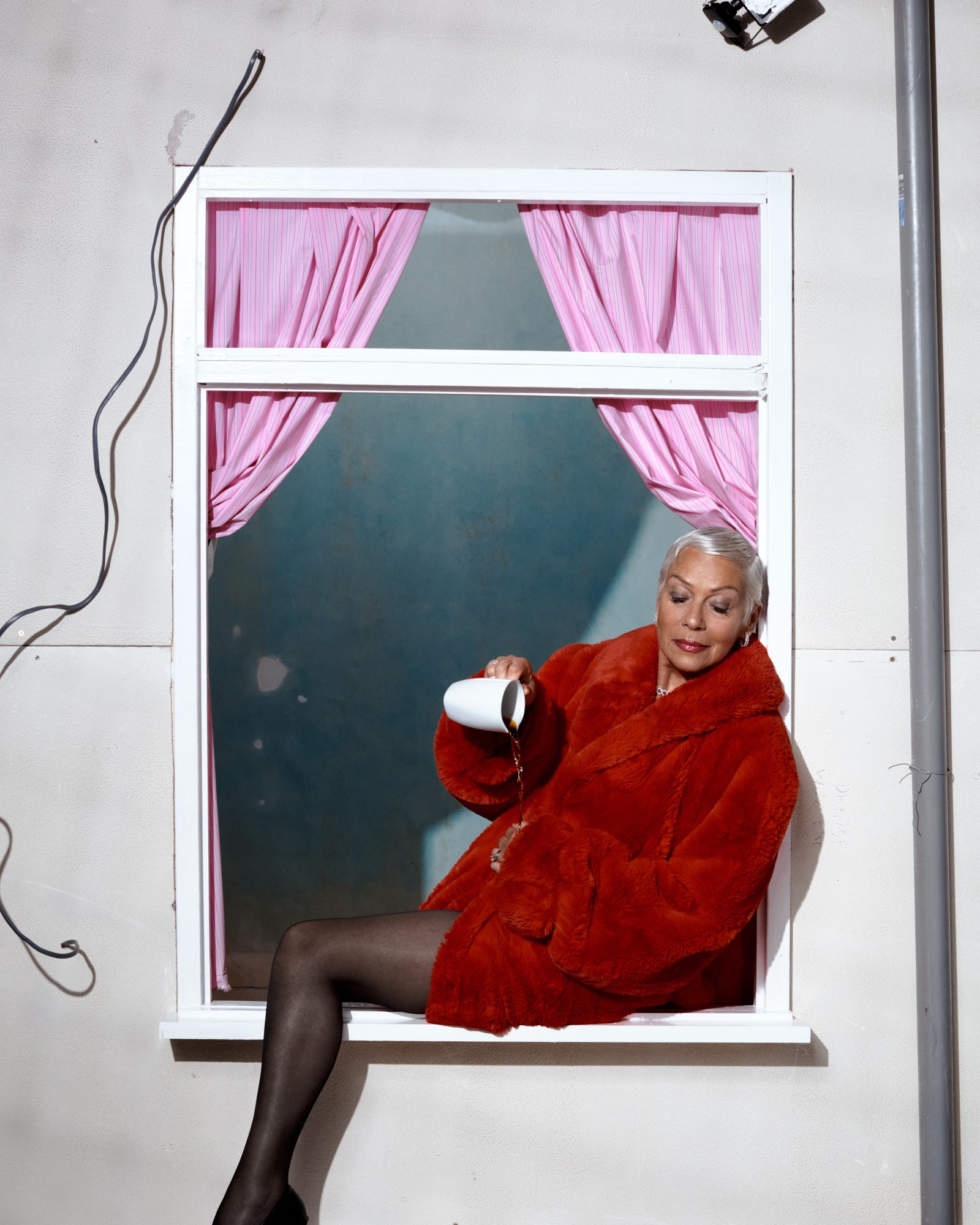
Denise Welch isn’t fussy. In the minutes before she arrives on the set of her i-D photoshoot, I text her publicist: Would she like a coffee? But Welch isn’t one for flat whites or cappuccinos. She wants one heaped spoon of freeze-dried coffee and three of powdered creamer. She nestles it in her hands as she pores over a rack of Balenciaga and Saint Laurent.
This is the life she’s earned, even if her route to this moment has been long and unpredictable. To some, she’s a lauded British TV star who, at one point, was watched by tens of millions several nights a week on the soap opera Coronation Street, and later, on the BBC show Waterloo Road. To others she’s the mainstay on Loose Women—the cheeky and outspoken panelist on the daytime chat show which she’s appeared on for nearly 25 years, earning her A* hun status in the UK. Then there’s a comparatively more recent development: to young millennials and Gen Z, she’s the mother of Louis Healy, an actor, and Matty Healy—a rebellious, music-loving kid who, as a teenager, started The 1975 with his best friends. They would meet at her house. Welch was there, making dinners and mopping up after heartbreaks the whole time. She’s also made a foray into music herself: In a recent attempt to stage another side swerve, Welch has dropped a single, titled “Slayyy Bells” paired to her collaboration with the chocolate brand Celebrations, and is vying for the UK’s Christmas number one.
“This country likes to pigeonhole you,” Welch tells me a few weeks later, as we drink tea and eat fish and chips on a rainy Saturday afternoon in London’s Soho. Lately, she’s realized she means different things to different people. We’re meeting at The Groucho Club, a private members’ club she spent much of the ’90s and early 2000s in, “until the bitter end of the night and beyond.” Back then, as her career transitioned—at least on the surface—from actor to personality, she’d be hounded by paparazzi as she left. “They’ve told me they would [try and get a drunk-looking shot] even if I was stone-cold sober coming out of a restaurant,” she says. “They said: ‘We felt for you, Den, but we were told that you were one of our number-one targets.’”
Her professional existence had been punctuated by a public one that tabloids twisted, so 13 years ago, she got sober with her now-husband, the artist Lincoln Townley. “I felt that people didn’t think of me as an award-winning actress anymore,” Welch says. Now, after a decade of Loose Women and guest stints on soaps, she’s ready to recalibrate and reemerge.
Late last year, “I said to my agent: I really want to concentrate on reminding people of what I do.” For a while, Welch had been frightened that her tabloid notoriety had overshadowed her ability to be taken seriously as an actor. “It’s taken me a long time to learn that that actually isn’t the case,” she says, pointing her red lacquered fingernail into the wood of the table. “A lot of people are saying to me, ‘I’ve wanted to work with you for a long time. I’m so thrilled that you’re here.’” She’d like for this moment to echo what’s happened with Pamela Anderson lately. For people to see past a public image and notice the great performer that’s always been there.
Among those who came calling: Russell T. Davies, lauded British showrunner behind the AIDS drama It’s a Sin and Queer as Folk, who cast Welch in his next series Tip-Toe (“I did one lovely episode—I was proud to get it because I know how many others were up for it.”). There’s also Stepping Up, a comedy series from the team behind Big Boys and Stath Lets Flats, in which she plays the main character’s mother, who “lives on a barge and is a bit of a hippie.” Welch leaks her opening line—“Fuck off, you insane little gnome!”—before bursting into laughter.She’ll return to Waterloo Road as the sex-forward supply teacher Steph Haydock, too.
“You could put Demi Moore and Denise Welch in a supermarket, and by far I’d be the most famous!”
denise welch on the height of her fame
This feels like the level of commitment Welch wants right now—valued parts in respected TV shows that don’t consume every second of her time. She likes going on vacation with her husband and making sure she’s there for her two sons and her stepson when they need her. A Hollywood moment would be nice, she imagines, but she’s already experienced the glaring eyes of nearly a third of Great Britain (21 million people per night) in her Coronation Street days. Back then, “you could put Demi Moore and Denise Welch in a supermarket, and by far I’d be the most famous!”
These days it’s Matty who’s privy to that kind of visibility. He’s “quite chuffed” with the moment his mother is having. “Even my cool son is going, ‘I’ve never done a shoot for i-D before!’” Welch says, laughing. “If I’m watching Matty headline Glastonbury, or Louis do Stranger Things, everyone around me is going, ‘My God, you must be so proud.’” She smiles. “But I’m more proud of who they are. I’m proud of how they treat the people around them.”

The 1975 boys have been with her forever, so they feel like a de facto family too. “That band started when they were 12 and didn’t leave until they were 23. We fed them, we watered them. Every girlfriend came to us, a couple of them moved in after one date or something. It was wild, because we were also a bit wild,” she says. She’s proud of Louis, who just completed a year-long job as the lead in Stranger Things: The First Shadow in London’s West End. “When you have young children, it’s really quite easy—but nobody prepares you for the fact that you are emotionally tied to these two people for the rest of your life.”
She feels “every heartbreak, every job they don’t get,” she says. “They deal with it fine, but I’m the one weeping and wailing about it. I act like the Poundland Kris Jenner when I try to interfere!” Welch admits she’s become a bit of a helicopter mom. “I am definitely the person that calls more,” she says. She has a process for pinning down Matty: “I’ll ring on FaceTime Audio—no answer. I’ll ring on normal phone—no answer. Then I’ll ring on the email thing—no answer. That’s when George’s phone goes, and he’ll say, ‘Matty, it’s your mom!’” Recently she got a message back from Matty after attempting this process: a photograph of the overbearing mother from The Sopranos. “He’ll go, ‘I’m in the fucking studio!’” she shouts, gesticulating with both hands, laughing hysterically, then shrugging. “It’s often not even important. I just want to chat.”
She is a genius storyteller. At one point, I ask what grounds her in the midst of attention, and she launches into a magnificent tangent about the time a group of men high on spice surrounded her and her husband in the middle of nowhere in Palm Springs, and how she could hear the true-crime voiceover announcing her own murder in her head. Then, after about seven minutes of speaking, she found her answer. (It’s American true-crime documentaries, which she falls asleep to, and Real Housewives.) Listening to her talk about her life is like witnessing a really good acrobat stick the landing after an elaborate handspring vault. It feels like she was born to do it.
She developed this skill as a child, drawn to the dramatics by two things: her aversion towards traditional education at an all-girls catholic School in Newcastle Upon Tyne, and the fact that her dad was a drag queen. They were a sociable family, and oftentimes, “they decided that they didn’t want to leave me, so if they were going to a party, I’d go too.” She fondly remembers the story of one soirée at which her mother dressed up in a tuxedo and bowler hat and her dad wore a dress—becoming, as he called himself, Raquel Welch. His family was in the confectionery business (Welch’s school nickname was Truly Scrumptious), but as a drag performer, “he formed a local amateur group where they would go around the old people’s homes,” Welch recalls. “His humor was quite blue, but the old dears, they bloody loved it!” In his fifties, he won Club Entertainer of the Year. That was his own kind of late-stage renaissance.
“He loved the attention he got. That’s how he was very different from us,” Welch says. “On holiday, he loved nothing more than making friends with a big bunch of Brits, and then on the penultimate night, when they all adored him, he would disappear—and Raquel would appear.”
As a kid, Denise embraced her dad’s outrageousness. She wasn’t naughty at school, but she loved socializing and didn’t care for her classes. “I just couldn’t understand people’s concentration on the boring history teacher,” she says. Four years ago, she was diagnosed with ADHD. At 15, she transferred to a local grammar school and met a life-changing drama teacher, who then pointed her toward Mountview drama school in London. Her acting life began there.
In between acting roles, Welch has been one of the main panelists on Loose Women, Britain’s version of The View. It’s been her longest-running professional relationship—nearly 25 years. She’s appeared on nearly 900 episodes. She’s known for boldly saying the quieter part out loud; a contrarian but not necessarily controversial. She’s still close with the group and will stop by every so often even though her life priorities have shifted. As with all TV in Britain these days, rumors of change surround it. Welch says, “Loose Women has been very good to me, and I’ve been very good to it, and I will continue to do Loose Women.”

The show has helped transform her into a voice of the people in Britain, particularly for women—especially those suffering with mental health issues. “Alcohol and drugs blighted my life, but that’s because depression blighted my life,” she says. She suffers from endogenous depression, a kind with no catalyst, chemical and unpredictable. “If someone said to me, you can have five more years being depression-free or 15 with it, I’d take five years. It’s the most horrific illness.”
It flares up unexpectedly. In 2019, sensing its arrival, Welch decided to document her episode in real time on Instagram, and came out of it to find it had become front-page news. Those around her now know how best to help her. When a depressive episode reared its head again last year, just as Welch was preparing to do a pantomime, she stepped back and recovered. In the past, the tabloids might have eviscerated her—blamed her addiction or claimed she was lazy or faking it. Instead, everywhere she looked, she saw solidarity. It’s the kind of response that comes from years of putting yourself out there, of offering up the unflattering parts of yourself because you know others have them too.
“I used to be frightened of happiness and contentment, because my illness would always come and rob me of it,” Welch says, pouring the last drops of tea into her cup. Where there were once villains in her life, there are now people who love her—her national treasure status solidified. “I haven’t been frightened for a long time,” she says.
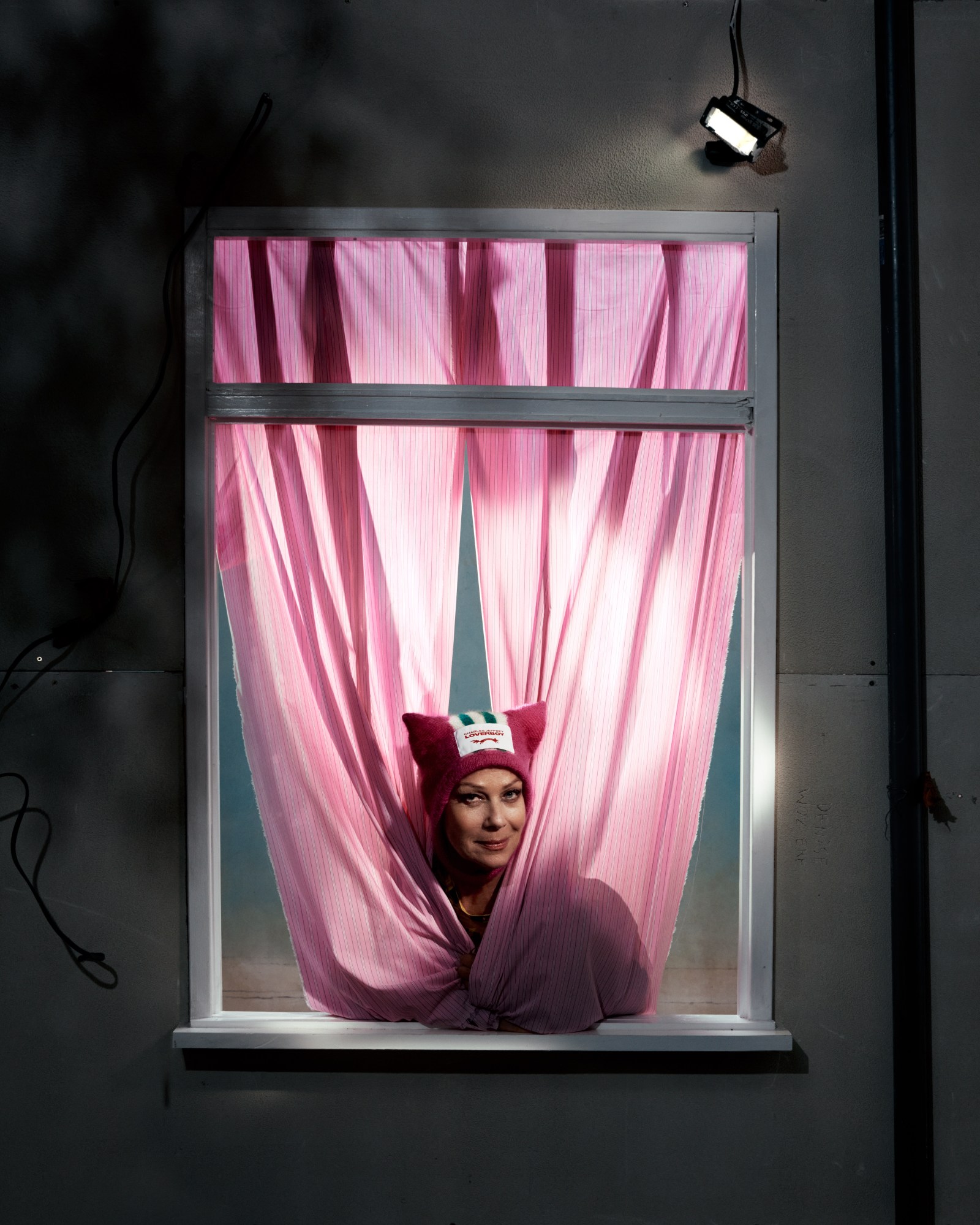
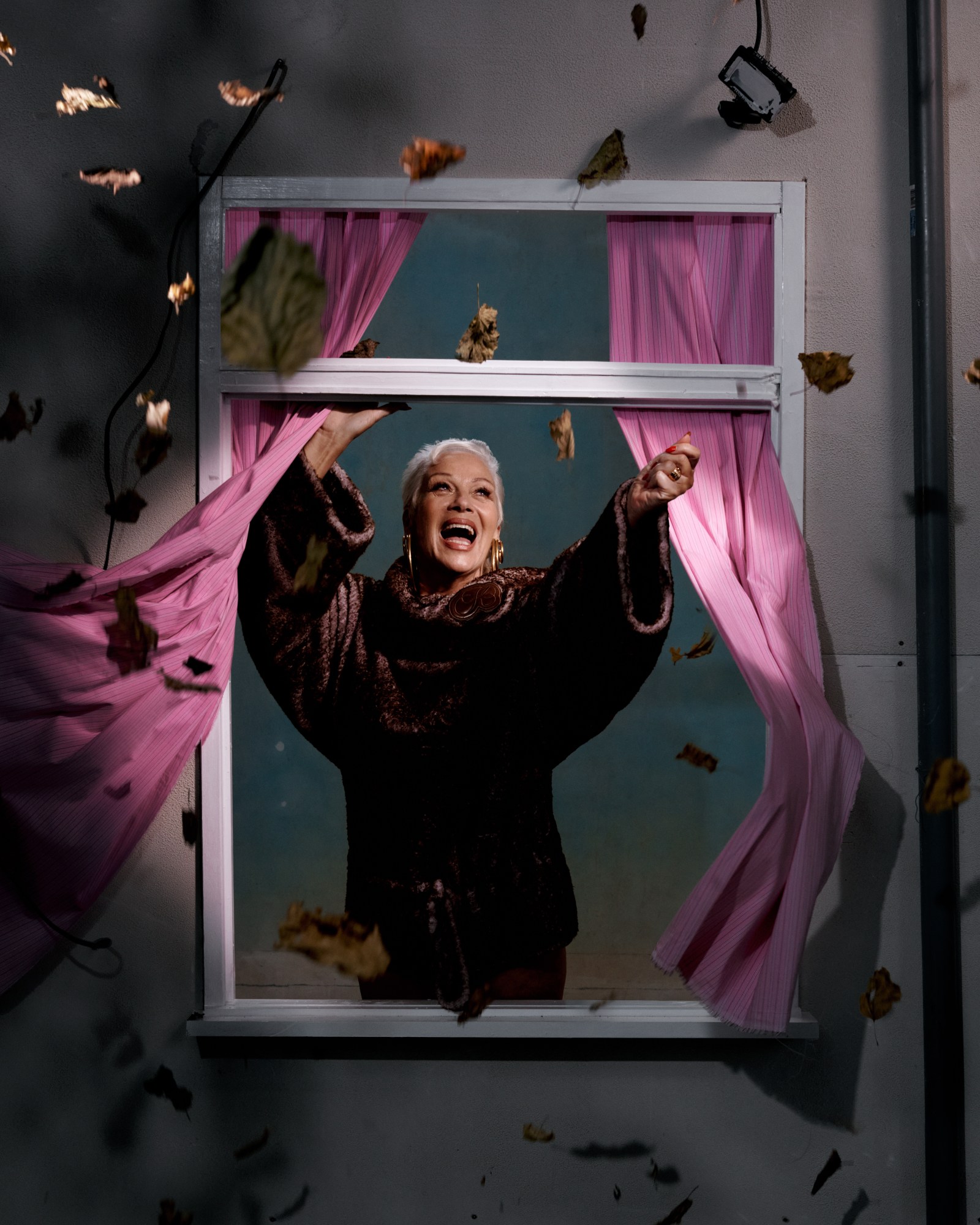
in the lead image COAT KNWLS, EARRINGS MISHO, RING FINGER RINGS MAZARIN, LEFT PINKY RING VICKiSARGE.
hair CHARLES STANLEY
makeup GRACE ELLINGTON
set design RORY MULLEN
photo assistant CHRIS PARSONS
second assistant JOE DABBS
set assistant PETER EASON DANIELS