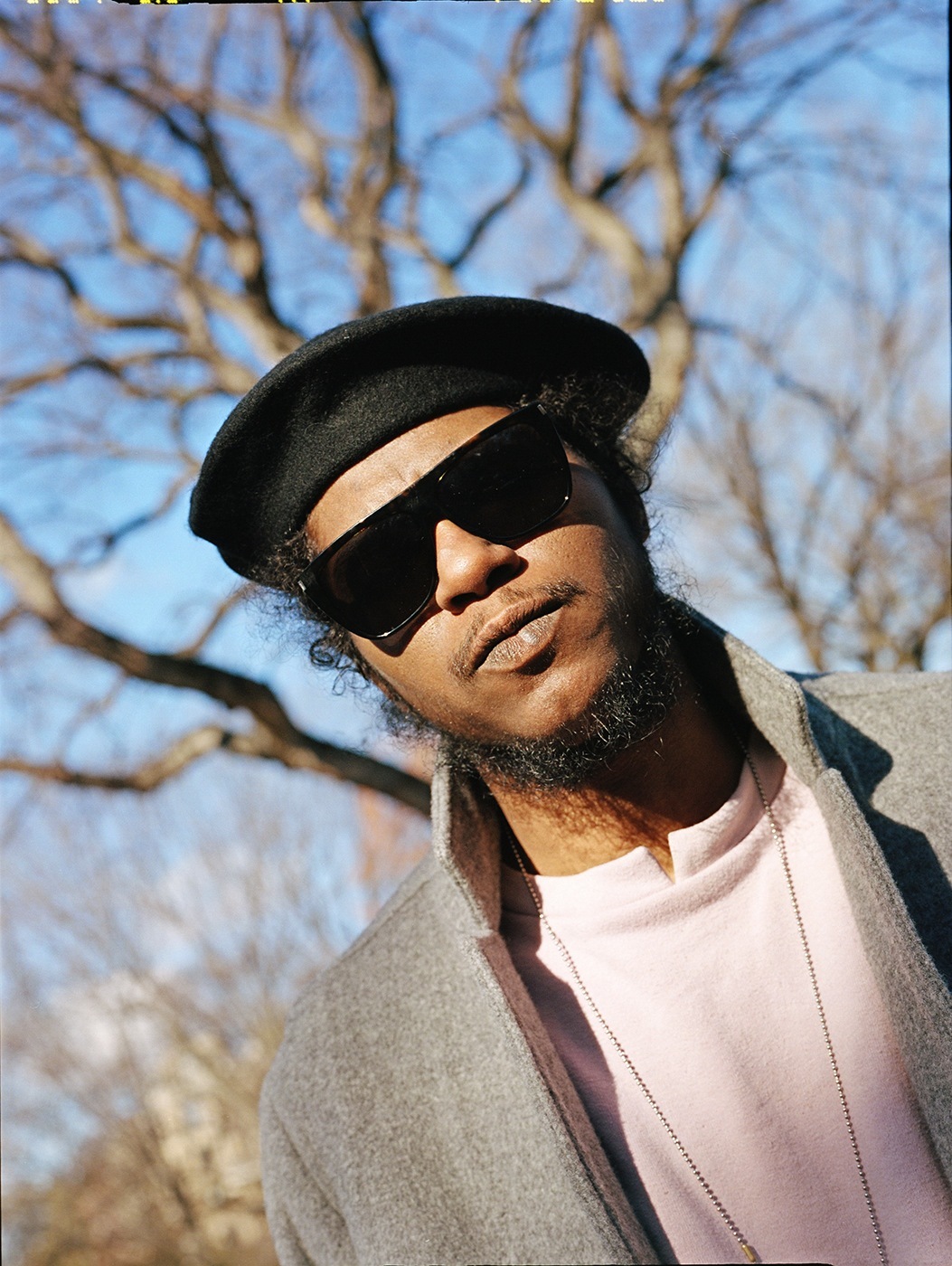
When I meet Ab-Soul, on St. Mark’s Place on a bitterly cold Friday morning, his newest album, Do What Thou Wilt, has been out for ten hours. Even if I had spent all night listening to the explosive offering, there’s ab-soulutely no way I would have been able to digest, or even detect, all the ideas and images the Southern California native has packed into his fourth full-length record. Soul isn’t at all irked when I arrive without a full grasp on Do What Thou Wilt‘s myriad ambitions. “Good,” he smiles knowingly, “that’s exactly how I want people to react.”
Soul (or Herbert Anthony Stevens IV to his parents, who owned a record store called Magic Disc Music where he worked every day growing up — even after contracting Steven-Johnson Syndrome, a rare virus that has resulted in light sensitivity and the loss of his vision) has been signed to one of hip-hop’s most formidable independent record labels, Top Dawg Entertainment, for almost a decade. Achieving early acclaim for his Longterm mixtape series, Soul — who wrote his first verse to lightning-tongued rhymer Twista’s “Emotions” at 12 years old — simultaneously earned a reputation as the most lyrical member of supergroup Black Hippy, a dream quartet rounded out by his labelmates and frequent collaborators Kendrick Lamar, Jay Rock, and ScHoolboyQ. Soul often weaves sight-related metaphors through meticulously constructed, yet elastic verses. He recrafts this lucid language and imbues it with double and triple meanings, building richly layered meditations on religion, philosophy, consciousness, politics, the human condition.
All of these elements intersect on Do What Thou Wilt — Soul’s first record in over two years, and one that proves his lyrical reputation’s truth. Soul’s inflection and energy shape-shift across its 16 tracks, created with 14 different producers. Despite DWTW‘s chameleonic sound and vast lyrical landscape (even single tracks, like the ScHoolboyQ-featuring “Beat the Case / / / Straight Crooked” morph profoundly), at its center is a message about the complexity of love in a world like ours.
This has been a really crazy year. How did you start to think about what you wanted to say?
As soon as I finished the last [record], I wanted to start immediately; and it’s probably been a good year and a half for the concept to grow. It’s based on Aleister Crowley’s The Book of the Law. That’s where the quote comes from: Do What Thou Wilt. The basic theme of the book is “love is the law.” Love is the only law. Love under will, the law is for all. From there, [the book] gets into breaking down Egyptian theory, ideology. What if God could be a woman? What if that’s possible? It’s a real wicked book, if you’re into journalism, poetry, and different philosophy. Above all, I like that he says how the righteous will remain righteous, and the filthy will remain filthy. Through all this, he still has consciousness: this isn’t for everybody, and so if you’re gonna be righteous, be that too. It’s not do what thou “want.” It’s stronger.
To me, “D.R.U.G.S.” really represents that love component. Tell me about that song.
The acronym is “don’t ruin us, God said.” I got that from Lupe, from one of the records we did on his last album. That stuck with me. In terms of busting down this album, it’s interesting to me that most drugs are code named as women — even down to heroin. But heroin on the street is called “boy.” That shift is interesting, right? I feel a repetitious desensitivity of women. Think of the ISIS terrorist group. “Isis” refers to the mother of the original holy trinity: mother, father, son. The most current [Christian] holy trinity is the father, son, and holy spirit — the woman being removed. Young kids, when they hear the word ISIS, they’re gonna immediately think of the terrorist group, and further remove [women] from the original story, which I think is interesting. It came to be time for me to talk about these things. And it’s for the girls, so I appreciate that you see it.
Mac Miller features on “The Law.” Earlier this year, he released The Divine Feminine, which is his exploration of love and of women. Had you guys connected about these ideas?
Absolutely. Me and Mac spent a lot of time working together over these past few years. He was letting me use his spot to record. I met my engineer, Josh Bird, through him. We have a chemistry that’s rare, and he’s my boy, so I feel like we were coming up with this idea together. I spent Thanksgiving with him and his mom cooked dinner for us. These ideas, they kind of met.
Shifting gears, I wanted to speak with you about visuals, in particular the video for “Huey Knew.” Tell me about that song and how you chose to represent it visually.
Because of my lack of vision, I usually leave the visuals up to the creatives in that department. But I knew I needed the chair that Huey Newton stood on, and I wanted to make sure the depictions that cycle in the background weren’t just racial. Because — and this is something the song considers — the party isn’t about black supremacy. It’s about equality. You would think he was talking about black people, black kids, but he was talking about Americans. I feel like [Newton] was trying to prepare us for this time. And he did it all with a smirk, if you watch him closely. He wasn’t stern. He’s one of my biggest inspirations.
What do you hope people take from this record, on the first listen, on the second listen, and after that?
It’s a whole lot. If you can believe it, I’m still coming to terms with how much this really is. But, if you’re gonna take anything from this; love is the law. The will is supported by love and passion. Follow your heart, you know what I’m saying? If you’re gonna be ill, be ill. If not, look yourself in the mirror and be good. Love yourself. I love my mama. Think about, when we’re outside and doing things, every little move we make, think about what your mom would think. The umbilical cord does not go away, even if she’s gone. That’s really want I want people to take, amongst all the bars and the metaphors and similes. Have fun with that. We’re gonna be busting that stuff for a long time, but if you’re gonna take anything from this, take the love.
Credits
Text Emily Manning
Photography Eric Chakeen