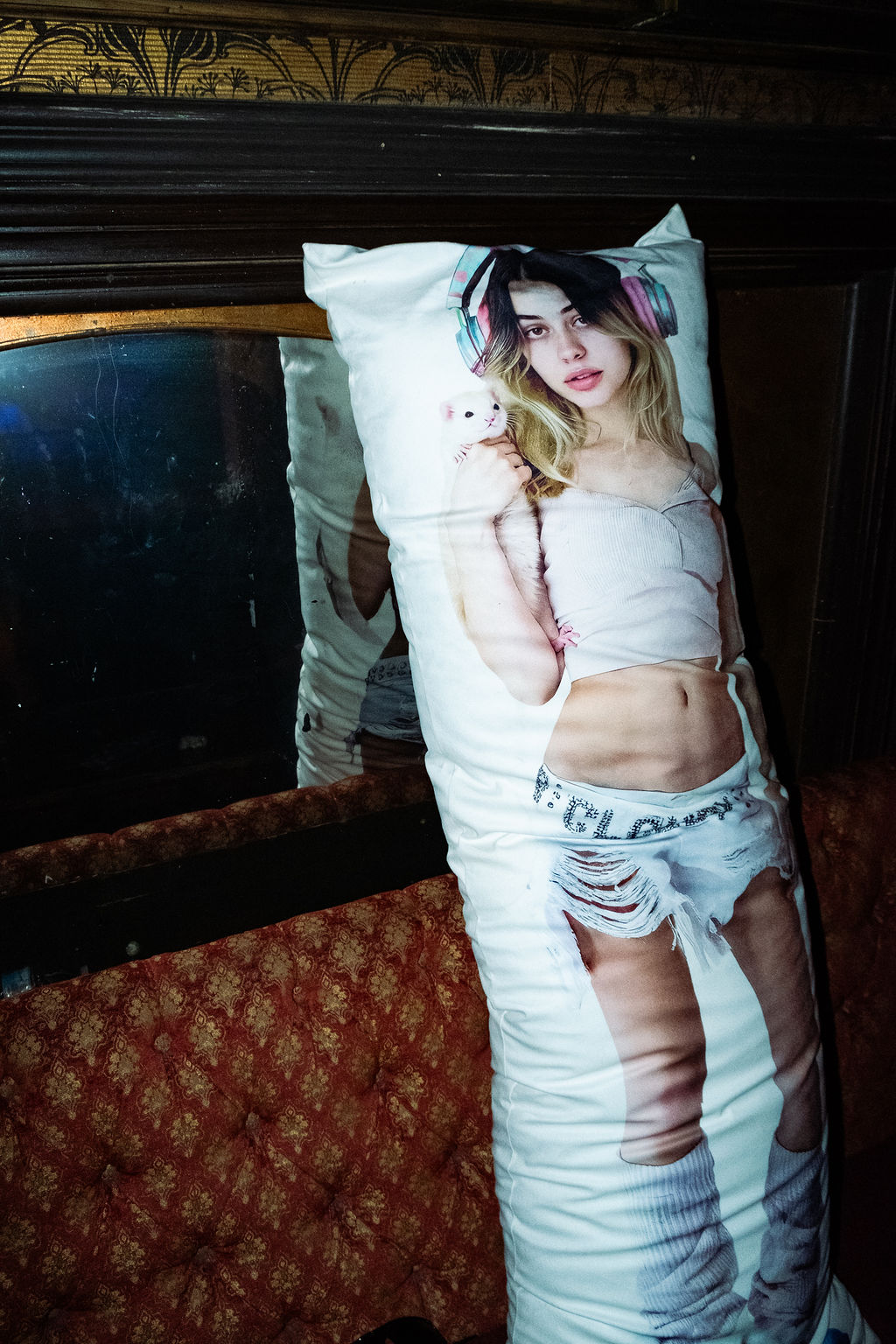
photo courtesy of ISRAEL ANGELES
Last Wednesday night I went to a release party at Madame Siam. Outside, people stood around smoking, which in Hollywood counts as an event in itself. We were here to celebrate the debut album of a new musician.
Her name is Cloudy Heart. She loves NFTs and energy drinks, has a pet ferret she occasionally consults for aesthetic approval, and vapes (a lot). She skips dinner and shows up two hours late to your party in a T-shirt she borrowed months ago and never returned. She makes music in her bedroom, but when she isn’t, she’s posting girlish existential aphorisms like “i’ve been staring at a dark wall for hours trying to make sense of nothing” and “i used to write in lowercase to feel smaller, now i do it because Capital letters feel dishonest.”
She also isn’t real. Conjured by digital artist Jon Rafman as the breakout star of Main Stream Media Network (his new AI-powered television channel), Cloudy exists solely in code. Or, as her Spotify bio puts it, “trapped in the place where dust particles cling to pixels.” Rafman has spent over a decade cataloguing the ambient dread of life online, exploring how a medium designed to connect people ends up making us even more lonely. This is his first foray into something resembling pop music. Previously his work, Nine Eyes, which archives strange, unguarded screenshots from Google Street View, and Dream Journal (2016-2019), a surreal VR world drawn from gaming aesthetics, traced the eerie afterlife of images once they slipped free of human intent. Channeling MTV’s golden age, early YouTube celebrity, and social media feeds, Cloudy is a popstar optimized for our doomscroll era.
Despite knowing she was just code, I couldn’t help imagining her slipping in through the doorway late, drunk, unapologetic, already bored by whatever she’d made all this for. Around midnight, I thought I spotted her silhouette in the dark, but it was only a body pillow with her face on it, propped carefully against a wall. Her image flickered beneath the DJ booth on a row of screens: Cloudy staring past the scene, a porthole framing some faraway horizon. Her debut album, $REAL, features tracks like “There is No Origin,” “Reply Guy,” and “Automate My Fate.” The sound is grungy and hypnotic, a washed-out mix of glitchy post-internet textures, as if it’s being transmitted through a dying phone signal.
Unlike virtual idols such as Hatsune Miku, whose songs are composed and produced by humans but performed by a digital avatar, Cloudy Heart’s music is a hybrid of human and AI creation. Rafman describes the project as “a true artistic collaboration involving multiple talented individuals,” insisting the technology functions as a medium, not a message. Participating artists receive equity in the project, which he explains is an attempt, however speculative, to imagine collective ownership in an economy that routinely strips creators of value. And, despite her origin, he says that the team behind Cloudy makes her heart “authentically human.” She sings about lying awake at night, numbing her emotions, wanting to disappear. It’s familiar territory, which may be what unsettles people most. Not that she isn’t real, but that the feelings she produces can be.
The scale of AI music is hard to ignore. Once laughable, platforms like Deezer now receive tens of thousands of fully AI-generated tracks a day. AI musicians like Xania Monet are signing multimillion-dollar deals, viral songs like “Walk My Walk” by Breaking Rust are climbing Billboard charts, and startups like Suno are raising millions to “verticalize” the market. The technology is no longer a novelty.
British musician, songwriter, and producer Dave Stewart, Annie Lennox’s other half in the Eurythmics, recently framed it as an “unstoppable force,” arguing that musicians and other artists should license their work to generative AI platforms, or risk having it appropriated anyway. Stewart imagines a future where artists who own their intellectual property can treat AI as a tool, and even use it to loosen the grip of the industry structures that have historically profited from their labor. Yet not everyone shares his optimism—myself included. Some worry that no licensing or strategy can preserve the human spark that gives music its emotional force, and that AI, even well-intentioned, risks turning expression into replication.
Cloudy Heart, however, isn’t positioned as an industry competitor. Musician Autumn Ludi, who has been writing and creating visual “dream journals” for Cloudy since the project’s inception, describes her as a “hyperstitious entity: the digital embodiment of Tiqqun’s Young-Girl online.” The Young-Girl, Ludi explained, isn’t a person so much as a condition: desire, consumerism, and performance compressed into a single figure, neither strictly young nor female, everywhere and nowhere at once—designed to be looked at, wanted, and endlessly reproduced. “It’s vital that we understand what is truly good and what is truly bad at this point in history,” Ludi says. “Cloudy knows this, which makes her a Trojan horse for a new human mythos.”
As for what partygoers thought of Cloudy, opinions ran the gamut. Genevieve Sky, one of the night’s DJs, described her as an internet personality with a Skins edge: “She probably loves Xanax and iPhone 4 camera quality and weaseling her way into seedy after-parties at Chateau Marmont.” Shigecki, who spun the closing set, pictured her listening to Taylor Swift on the way to get matcha lemonades in Venice. Another girl I overheard was less convinced. “It’s like, cute?” she said, exhaling smoke. “I don’t really get what this is about.” But no one seemed disappointed that Cloudy wasn’t there, maybe because everyone already knew she wouldn’t be.
To me, Cloudy is a modern echo of Martin Buber’s two modes of being: I–Thou and I–It. I–Thou is genuine encounter; I–It reduces the other to something to be consumed—like the body pillow. Whatever was happening here didn’t quite fit either mode.
For all the talk about Cloudy, the party itself was ordinary. By 1 a.m., the night had settled into its rhythm. Inside, a few people danced; mostly, attendees loitered outside, none eager to document it. Scrolling through Cloudy’s Instagram on the ride home, I kept waiting for the uncanny valley effect to kick in. But it never did. Maybe because so much of what she posts is inspired by what we do. Maybe Cloudy just wants what the rest of us secretly want: to exist in the background of someone else’s night.