
In late October 2005, violence erupted on the streets of Paris. In the banlieue, Paris’ poorest suburbs, long brewing problems of unemployment, police aggression, and social prejudice ignited angry confrontations between disenfranchised youth and French authorities. Houda Benyamina, a child of Moroccan immigrants, was there. She felt the anger and rage in the three-week standoff, sparked from the deaths of two French youths of Malian and Tunisian descent. A 25-year-old student at acting school, she too felt the urge to go on the offensive. “I reasoned with my inner circle, but at the same time, I wanted to go out and smash everything up, too,” she says now. Houda’s inner reasoning won out at that time and a decade later, those frustrations have found creative expression in her debut feature film Divines — a lively, richly complex take on life for immigrant communities in contemporary Paris.
Divines tells the story of Dounia, a 15-year-old French-born child of African immigrants who lives with her family in a Roma camp, a shanty town that’s a depressing rung below the poverty level of the banlieue. Dounia is mouthy and energized, a young girl who is greedy for money and the good life and sees only illicit ways to get there. The advice of a teacher at vocational college to play nice and get a job as a secretary doesn’t float Dounia’s boat. She’s more interested in a route to riches, to the “money, money, money” of the Lil Wayne track she mimes to mock her teacher.
The fast track to the high life lies with Rebecca, a tough, local drug dealer. Dounia, intent on impressing the ringleader, steals dope to prove Rebecca’s drug runner isn’t up to scratch. “You’ve got clit,” Rebecca says to her new charge. The line is Divines‘ director’s own and could equally apply to her own career path, which has an against-the-odds narrative to it. One year after the Paris riots, Houda founded 1000 VISAGES, an association that scouts and nurtures young talent from social minorities. “I founded the association because I found cinema white, bourgeois, and misogynistic,” she says. “Even when you graduate from one of the grandes écoles, it’s complicated imposing yourself without a network, especially if you’re black, Arab, and a woman on top of it all.”
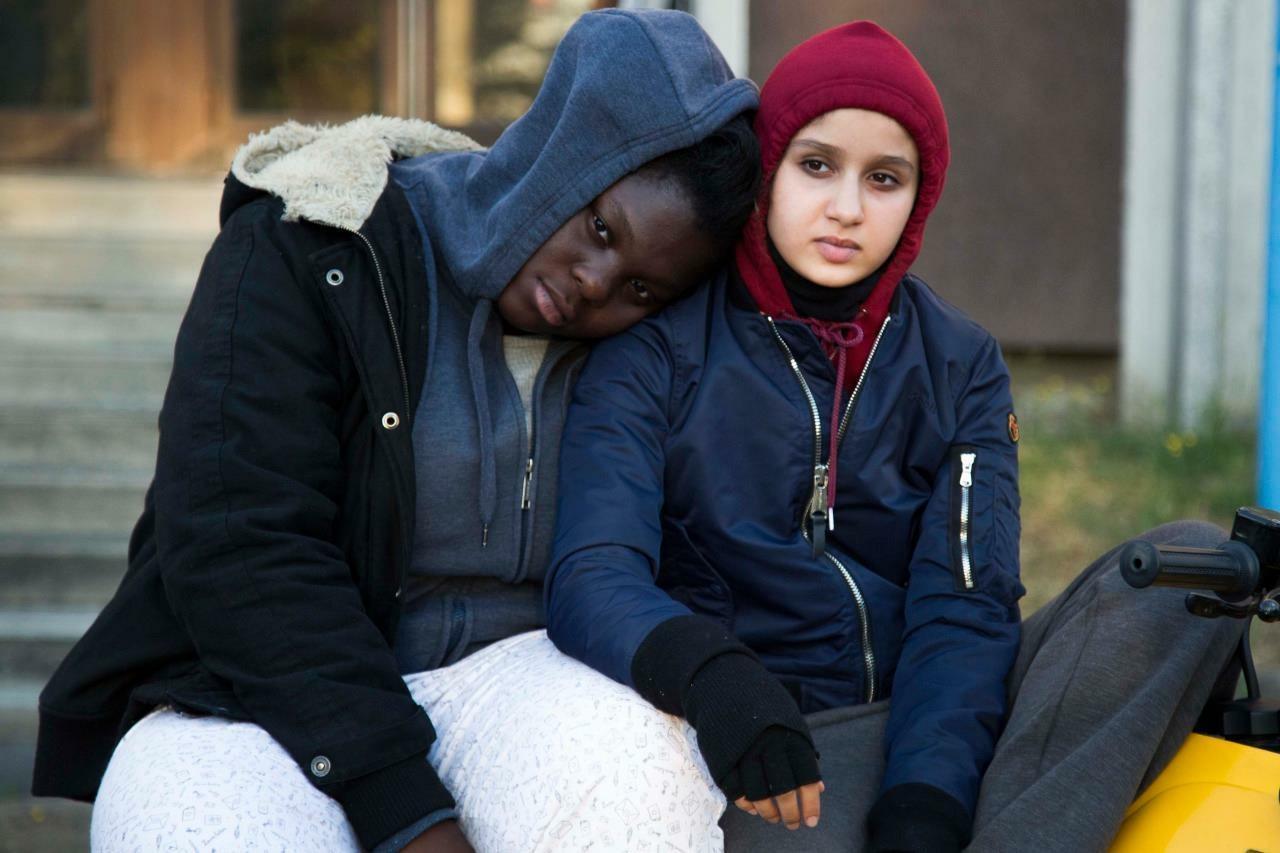
Houda experienced those complications first hand, as she battled with financing and distribution of Divines. It has been a fight worth having. This year, the film won the Camera D’Or prize at Cannes for Best Debut Feature film and Netflix picked up distribution rights. Divines sits within the social realism strand of French cinema typified by La Haine, the 1995 drama that shone a stylized light on France’s suburban social ills. But Houda’s film is no repeat of twenty-year-old politics. The film is as much about the search for meaning as it is identity. There is much in common with Céline Sciamma’s Girlhood from 2014, another banlieue-set celebration of female friendship against a backdrop of systematic gender and racial oppression. Houda finds the divine in the female friendship between Dounia (played by her real life sister, Oulaya Amara) and Maimouna (Deborah Lukumuena), who is also a French-born child of African immigrants.
Houda was inspired in part by the physical comedy of Laurel and Hardy in creating the dynamic between Dounia and Maimouna, Without each other and the Snapchats, spliff smoking, and spying on a local dancer they fancy, the girls might not survive the poverty of their lives. Though Houda resists the feminist label — she says she’s made a humanist film — her female characters are fully rounded, complex young women, even if they are placed in traditionally male dominated roles.
“It was important that Dounia wasn’t just a girl playing tough guy,” the director says of her main character. “Like all of us, she is multifaceted: at times she is feminine, at others masculine — a daughter, a mother, a boss, a femme fatale, a bully, and a victim.” Even though in Divines it is the girls who turn the female gaze on men — spying on the dancer from the rafters of the local theater — is in no way a straight gender reversal story. “The search for recognition and power isn’t a male privilege,” Houda notes.
Dounia’s immediate goal may be greed but her real one is dignity. In Divines, her director gives it to her. “I often say that I could have set off bombs but I prefer to set off a dialogue,” the director says. “I hope that after the laughter, the crying, and the love with Dounia and Maimouna, the audience will question our society, our place at the heart of it, and above all the crucial role that intimacy plays in all of that. I hope that every single viewer questions the nature and the sense of their personal quest.”
Divines is available on on Netflix now.
Credits
Text Colin Crummy