
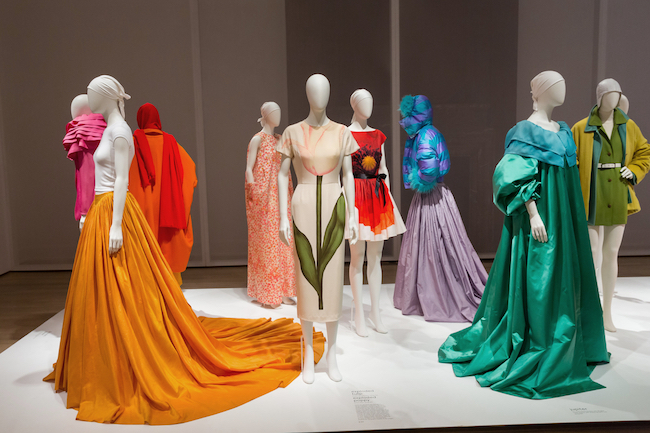
Isaac Mizrahi, American fashion’s voracious god of high/low mashups with an oeuvre spanning everything from mink coats to an elevator padding gown, doesn’t seem like he hates many things. But don’t get him started on mannequins. “I hate mannequins,” he declared to Lynn Yaeger at a preview of his new retrospective at The Jewish Museum on Tuesday. “Isaac Mizrahi: An Unruly History” is the first exhibition to focus on Mizrahi’s three-decade career. “I think a little shape, a little meat on someone’s butt and thigh, is quite a beautiful thing,” the designer continued to scattered applause and “mmm”s of assent from a room of mouths stuffed with Russ & Daughters bagels.
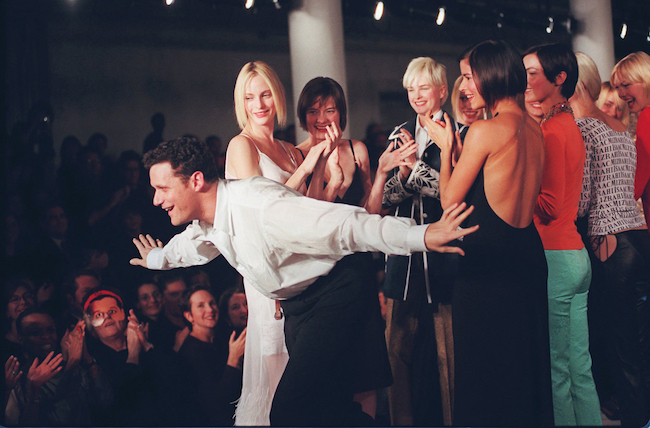
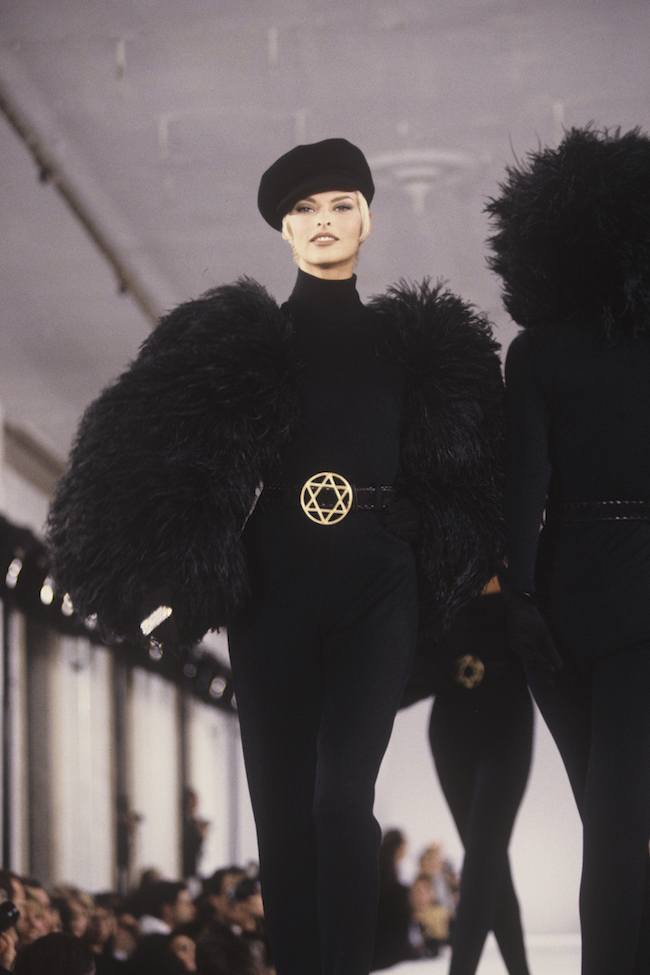
It’s true that the synthetic women showing off Mizrahi’s 30 years of beautifully irreverent garments can’t compare to the glamorous swarm of larger-than-life women who stalked his runways even through heroin chic’s 90s heyday. Mizrahi’s name will always be linked to those of Linda Evangelista, Cindy Crawford, Naomi Campbell, and Christy Turlington. But at the same time, the exhibition proves the clothes make enough noise on their own. Among them: 1994’s “Ballgown Sport,” a white cotton T-shirt paired with a lavish burnt gold skirt; 2006’s “Kitchen SinkPink Dress,” inspired by the neon light installations of Dan Flavin; and 1991’s “Blackbird,” an ostrich feathered hood with a stretch wool bodysuit and “Star of David” belt. Woven into the exhibition are accessories, original drawings, behind-the-scenes photographs, and a multi-screen video installation that flashes scenes from the designer’s autobiographical one-man cabaret show LES MIZrahi.
Ahead of the exhibition’s official opening today, i-D sat down with the multi-faceted man himself to talk about the casual brilliance of Keds, why expensive restaurants suck, and finding beauty in the image-saturated culture of now.
When looking back through your archives, were there any pieces you had a particularly strong emotional connection to?
I have emotional connections with every single piece, and for different reasons. Editing has never been my strong suit, especially with things that are so personally meaningful to me. It was not easy deciding which pieces to use. Starting work on it — the emotionality did not occur at first. I was there to see what we had, and to assess whether it would actually be possible to revive some things or to fluff them out again, because of the way they were stored. Even when we were shooting them I still didn’t have a reaction, because it was so scary trying to get them to look great. It wasn’t until everything was edited and laid out that it really hit me like a ton of bricks. That was only about three weeks ago.
I loved hearing you talk about women’s bodies vs mannequins. You’ve always championed diversity and personality in the models you worked with — did this come very naturally?
There were some models who were muses to me. I never identified one or two — but I used to fit on this girl Melanie Landestoy, and she was a muse. I reacted to her personality as much as I reacted to her tits. Everything about her was fascinating to me and inspiring. Also Maira Kalman, my dear friend — she is definitely someone who influences me even when I’m not with her. I look at things as though I’m Maira. Veronica Webb has always been a big inspiration to me. I always think of her as someone who knows exactly what she wants. And she’s smart — smart is a big part of it.
What is your take on the Instagram It Girls who rule the runways today?
It’s an evolution of that. And they’re models because of a few things — they’re discovered at a very young age, and manicured, and groomed, and brought through this process that’s almost like a baptism by fire. Every inch of them is scrutinized and groomed by insane, crazy experts. Then they’re run around the globe a few hundred times a year and they see everything. That’s a kind of exposure that even actresses don’t have. Linda Evangelista and Christy Turlington are the most worldly people I’ve ever met.
The high/low contrast has always been intrinsic to your aesthetic. Was this a reaction to what you were witnessing at the time?
It was an observation. I’m not easily duped — most of the expensive restaurants I go to are horrible. The food is terrible, the service is terrible… it’s just expensive. I think that is what people begin to equate with quality. Most expensive clothes that I’ve ever looked at are horrible. Most suits I’ve had fitted by tailors are unwearable. Expensive does not mean good. Usually it means that it’s worse, because it’s more expensive. I’m not saying that everything cheap is great — absolutely not. I remember when I was a kid working at Perry Ellis, and China Chow would come in to the studio. She would be wearing a Brooks Brothers shirt and a little Chanel skirt, and Keds — or not even as postmodern as that, it was probably a little Manolo heel. And she looked amazing. What’s better than a white shirt with a Chanel skirt? Nothing.
How does your interest and involvement in theatre and film play into your approach to design?
Just this morning I was watching this beautiful movie called The Rich Are Always With Us — from 1932, with Ruth Chatterton and Bette Davis. The clothes were just unbelievable. There was one thing that Ruth was wearing that just blew my mind. I sat up and grabbed the tiny pad next to my bed and I drew it. I had a really good idea based on something that she was wearing — a modern version of something that she was wearing. It isn’t an obvious cause and effect. It used to be — I remember when I was at Perry Ellis again, there was a movie called Chariots of Fire that everybody saw that year. It was very influential. People started doing clothes that looked like the 1920s — pleated skirts and longer jackets and cloche hats. Now I think inspiration and product are so random and disparate.
You’ve always had a huge appetite for culture. How does the inundation of images via social media play into this?
I was 20 in 1981, and it was the beginning of this glut of images. Just images everywhere. And what cuts through that? You don’t know, you just do stuff. When you layer Instagram and Snapchat on top of that it feels like someone’s trying to suffocate me. What’s good about it is that it creates these kinds of micro societies. I like being alone a lot, and i like being in the company of a small community. I can imagine what is intriguing about Instagram. It’s an evolution. It’s a different kind of smallness that is coming from this hugeness.
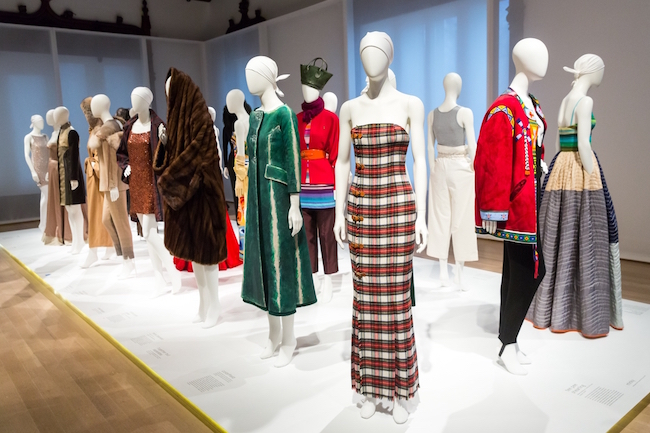
is on display at The Jewish Museum March 18 – August 7, 2016.
Credits
Text Hannah Ongley
Images courtesy The Jewish Museum