In 2010, the year before War Horse, Jeremy Irvine appeared on stage as part of the Royal Shakespeare Company – as a tree.
He’d had a small role in the now defunct TV series Life Bites, but it’s fair to say his acting dream was distinctly more Joey from Friends than he’d like. “I’ve had more rejection than I care to remember,” Irvine says when i-D meet him for a coffee in Soho, Central London.
Irvine is 23. His CV now includes the leading role in Steven Spielberg’s $100m first world war saga War Horse, and he has just shot films with Michael Douglas (The Reach) and Robert Duvall (A Night in Old Mexico).
He spent a year at drama school, but decided against a full degree. He spent his nine to five designing websites, and would film scenes with his friends on a handheld camera at the weekends. He put his own showreel together using Final Cut Pro, before telling talent agencies it was professionally filmed. “The agent that eventually signed me could see through it I think,” he says. “But liked the effort.”
After War Horse, Irvine got a rush of offers. But he turned most of them down. “I didn’t rush into anything,” he says. “I wanted to be careful.” A year passed before he appeared in Now is Good, a wittily written indie romantic-drama in which he starred opposite Dakota Fanning.
Now he finds himself sat in a Winnebago in deepest America, about to shoot his first sex scene and getting advice from Michael Douglas. “He has the best sex scenes in the world,” Irvine says. “He came into my trailer and I said: ‘Michael this is the first time I’ve ever done a sex scene.’ He gave me plenty of tips.” What did he tell you? “I’m not going to say,” he says. “Because then you’ll know all the tricks.”
Irvine lives in London with friends from his home in Cambridgeshire. His mother Bridget is a Liberal Democrat councilor who spends her time on social housing for homeless people, while his Dad works as a local engineer. Irvine prides himself on his privacy, on not getting involved in the largely artificial glitz of the film world. His mates help. “I made the mistake of putting up a poster of myself in my house recently that my mum framed for me,” he says. “The shit I got for that was outrageous. But it’s the way it needs to be. Sometimes, when people get some fame, they don’t change; it’s the people around them that change. That isn’t going to happen with me.”
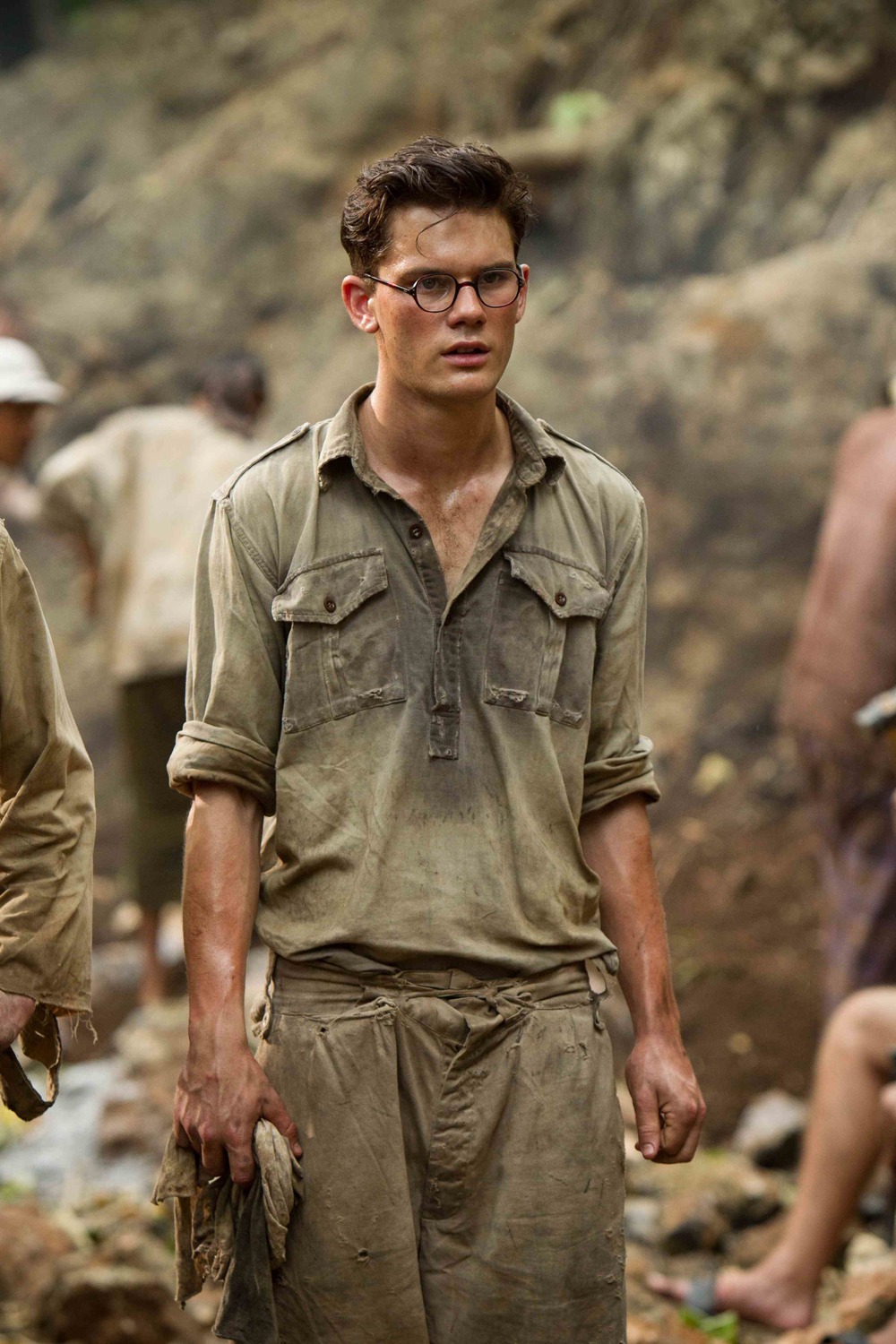
Irvine’s latest film is maybe his strongest. The Railway Man is an adaptation of Eric Lomax’s 1995 memoir, a minute description of the fall of Singapore in 1942, after which Lomax was forced to work on the Death Railway – a 415 kilometer section from Thailand into Burma that claimed the lives of 6,648 British and 2,710 Australian prisoners of war, not to mention 80,000 Asian workers. Winston Churchill called it “the greatest disaster ever to have befallen the British Empire.” After trying to build a secret radio, Lomax was horrifically tortured by Japanese soldiers. Based on real events, the film follows Lomax, now an ageing man, as he travels back to the scene of such heinous war crimes in an attempt to find his former torturer, Takashi Nagase, with the full intent on murdering him. Before The Railway Man, the Death Railway was known only through David Lean’s The Bridge On The River Kwai. “I have never seen such well-fed prisoners of war,” Lomax’s writes in his memoir.
Irvine lost 30 pounds to play Lomax. When they shot the scenes of Lomax getting waterboarded, Irvine told director Jonathan Teplitzky he wanted to be force-drowned for real. “The longest I lasted was about seven or eight seconds, and water just exploded out of me – you can see it in the film,” he says. “Eric went through that, day after day, for months. I don’t know how he made it out alive.” Irvine accepted he would never be able to understand what Lomax went through as a prisoner of war in the hands of the Japanese. But he wanted to get as close to Lomax’s experiences as possible. He spent time in Lomax’s home in Berwick-upon-Tweed learning from him before he died at the age of 93 in 2012. But when Irvine visited the Death Railway in Thailand, the suffering of the Allied POWs really hit home. “I helped some of crew clear a section of the railway that had been reclaimed by the jungle,” he says. “You’re working in 40 degree heat and 98 per cent humidity. We did maybe an hour and a half and I was wrecked. To imagine doing that for 16 hours, with barely any food and very little water – my eyes were open then.”
“You get a sense that these places are haunted by the ghosts of thousands and thousands of young boys, three years younger than me,” he says. “Eric Lomax felt ashamed of himself because of what he’d been through in the war,” he says. “But he made sure people like us can live free. Meeting him, getting to spend time with him, and then trying to replicate his experiences on film – that, right there, is why I spent so long trying to be an actor.”
The Railway Man is in cinemas now.
Credits
Text Tom Seymour