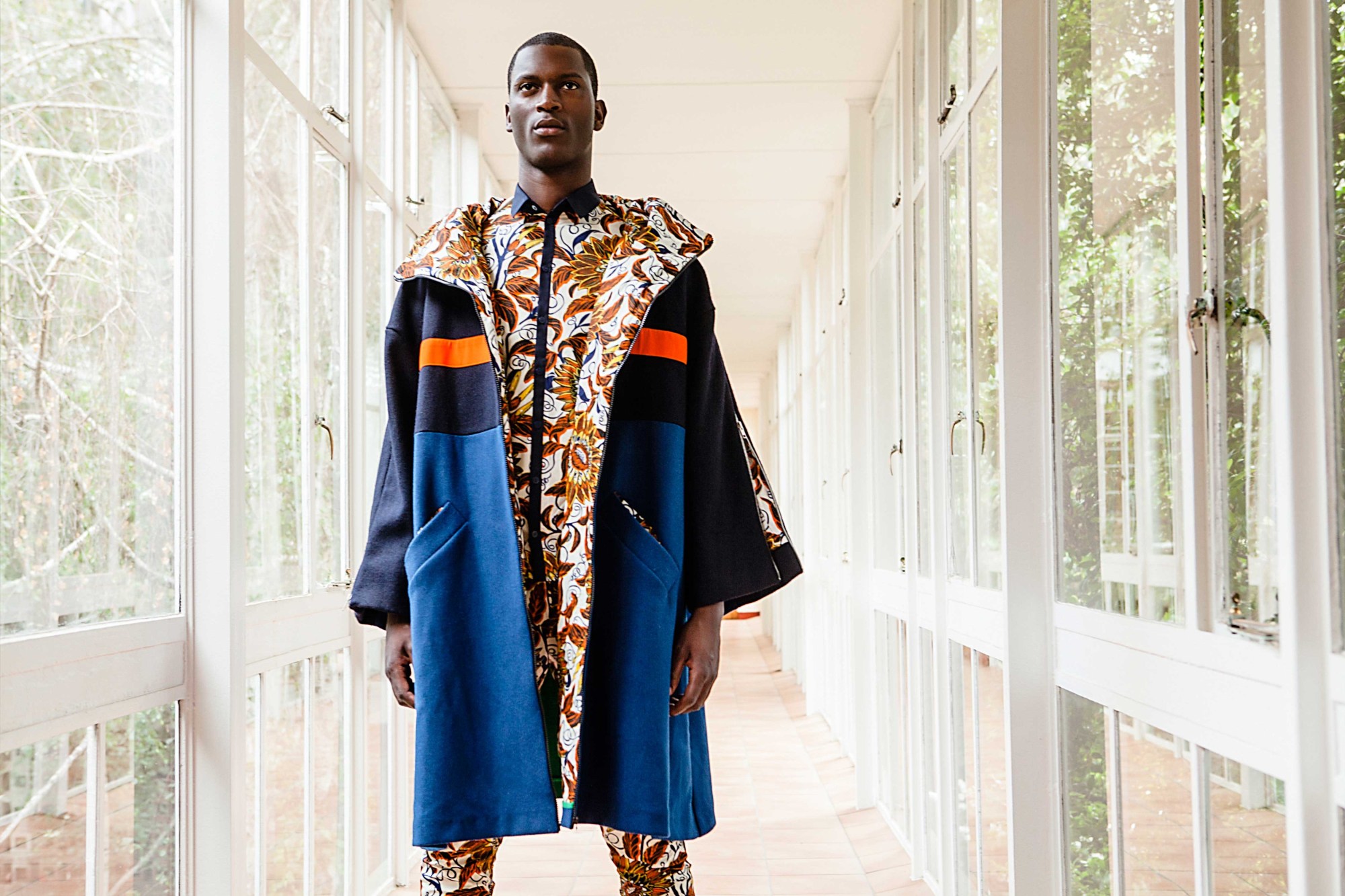
Her hair is held back in a turban and her feet are wrapped in hand-painted creepers. “I am a living fusion!”, says Laurence Chauvin-Buthaud with a wide smile, as she guides us through her atelier in Paris’ Marais.
Raised between the Ivory Coast and France, her mixed background is at the root of her menswear label Laurence Airline. Launched in 2010, it is based in Paris but produced artisanally in small workshops in Abidjan, the country’s capital. Collection after collection, it fights to establish a novel space for African fashion: “never kitschy, always contemporary.” The designs hence mix rigorously minimalist lines and conceptual touches of traditional local fabrics – earning the brand the nickname of ‘The African Raf Simons’. Back in town after closing this year’s Mercedes-Benz Fashion Week Africa last week, Chauvin-Buthaud spoke to us about the challenges of giving both a global and local relevance to Ivorian fashion.
What is the story behind the name of your brand?
I was born in a plane! I’ve actually spent a lot of my life on planes, mainly travelling between Paris and Abidjan. Today, that has become a metaphor for what I do, it symbolises a bridge between two cultures.
You graduated from Paris’ illustrious Studio Berçot – what made you decide not to work for a French house brand like most graduates?
I did actually, briefly. I worked for Louis Vuitton as an assistant to product manager, and I realised that working in luxury in Paris was going to be a daily battle. I didn’t want to fight to work and survive in that industry. So I took a month off to travel to Abidjan, ended up staying for six instead, and started to dabble with local fabrics. I loved their ever-evolving, deeply personal creativity: they are no two designs alike, they always reflect the craftsman’s personal artistic expression. I began making women’s clothes but kept getting encouraged by men to create a male counterpart. My first big commission was for musician Keziah Jones, who asked me to design a suit for him. I imagined an African cosmic super hero, and that’s how it all began.

When you first launched your brand in 2010 – then only offering shirts – what was your aim? Did you feel there was a gap in the market?
I wanted to offer a product both deeply African and universally wearable; there was a gap in refined, crafty African fashion that would appeal to a more urban audience. I began with shirts because I saw them as a canvas: a structure, a frame in which I can be creative, but which nevertheless gives me a minimalist contrast. I work with quite androgynous models, and the shapes are quite easy to wear, so a lot of women tend to wear my clothes. I like the idea of a pared down, creative functionality.
Does the term ‘African fashion’ upset you? It’s a continent, not a trend.
Of course, that description doesn’t really mean much. But I feel it is African designers’ responsibility to educate others on the vast differences across the continent, give historical, social, artistic cues about the region they come from. In other words, representations are limited and often come from a foreign eye, and there needs to be a lot more written material produced from an African perspective.
What are the main challenges you are facing today?
There are some points that need to be overcome: for one, the sad reality is that if I only use black models for a look book, I don’t sell a thing in Europe: people still need that sense of identification. Nevertheless, I increasingly appeal and get support from intellectual or artistic milieux who deeply understand what I do. Also, I honestly hope people stop seeing Africa as the next China, for its potential for cheap manufacture, but rather, focus on its exceptional craftsmanship that could benefit the fashion industry globally. Let’s hope it’s only the beginning!
Credits
Text Alice Pfeiffer
Photography Brett Rubin
Styling and Art Direction Laurence Chauvin Buthaud
Styling assistace Nicole Van Heerden
Production Vatic
Models Dave and Eden at Boss Models