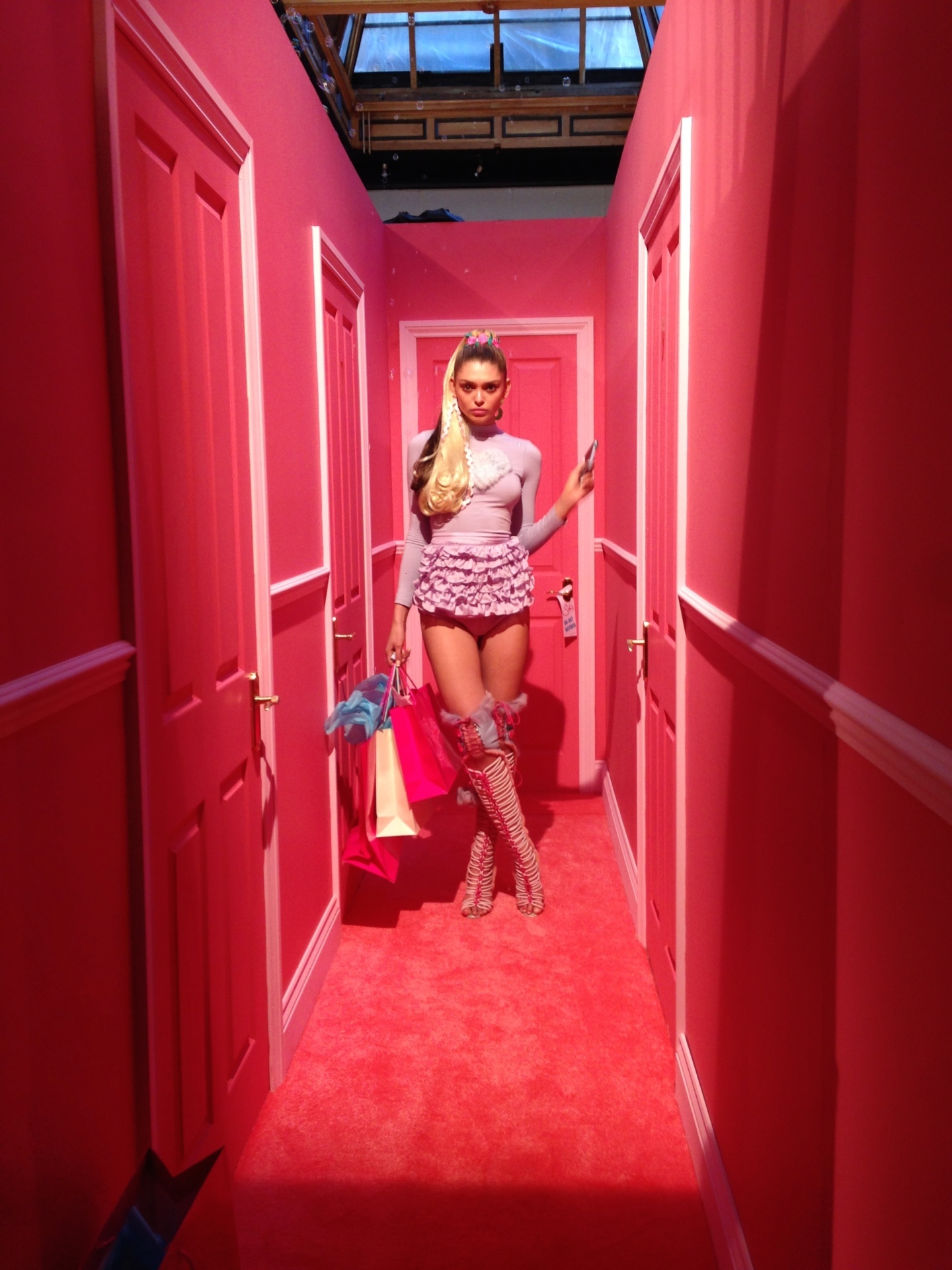
Named after the Dianthus flower, the colour pink has long been associated with all things soft and girly. The colour of dawn, the shade of sunsets, the rosy tints of the female flesh, and the pastel hues that decorate the rooms of newborn baby girls. About as punk as a packet of Crawford’s pink wafers, it’s a colour that has been used to stereotype and suppress women ever since red was first mixed with white. However, thanks to the invention of the internet, and the 90s Riot Grrrl revival it’s brought with it, things have begun to change.
It started with a picture of Britney here, and a flash of Baby Spice there, and grew as the wave of blogs began to break. No longer confined to posters on a bedroom wall, soon whole Tumblrs were awash with posts about My Little Pony, Hello Kitty, Barbies, rainbows, stickers. Like a scene from Fantasia or a peek down the rabbit hole into the wonderful world of Tim Walker, unicorns galloped from blog to blog, while mystical centaurs followed suit. It was all fairy tales and mermaids’ tails, as girls threw back to the 90s for their teenage clicks.
But, much like the punk movement of the late 70s, in terms of its DIY aesthetic and overall sense of social upheaval, this time there was something different, something defiant. Indeed, no longer the trope of female oppression, the return to girlishness became one of rebellion. Like a thorn amongst roses, candy coloured pictures of Kate Moss flipping the bird, Uma Thurman wielding a gun, and Lil’ Kim ramming her sexuality down your throat, began to cut through the cuteness of all things pink and girly. Cool girl-blogs by Bella Howard, Bip Ling, and Badlands777 started to replace the old print fanzines, while the iconic image of Natalie Portman as Mathilda Lando, the 12-year old assassin in Léon, became the calling card of the new riot grrrl digi-generation. And, putting the POW in girl power, it wasn’t long before it spread to the street.
“I think the influential generation at the moment grew up with the Spice Girls, Gwen Stefani, Courtney Love, Barbie, and Clueless. I love the colours, the nostalgia, everything about the way they look and how fun it is. Girls can wear what we want and dress how we want but be equally as strong or powerful.” Lola Chatterton
“Those teens who made digital zines in their bedrooms are now a little older and making more grown up fashion, art and music,” says stylist Louby McLoughlin, fresh from working on Sophia Webster’s fuscia fantasies for autumn/winter 14. From bubble baths to bags with speech bubbles (“but I’m not in love with you”), and cool girls with cornrows to mini gobstopper heels, Webster’s Heartbeak Hotel presentation was a pink paradise for the modern girly girl. Steeped in a heavy sense of nostalgia with it’s 90s references to Clueless, the Spice Girls, and Gwen Stefani, but very much weighted in the here and now, with each model tapping fiercely away on their Kawaii-cased iPhone, this wasn’t just sweet dreams and cute memes, it was girlishness as inflected by a sense of youthful rebellion and female empowerment. And she’s not the only one to be doing it. Other young creatives reclaiming the language of girlishness are designers like Ryan Lo, Ashley Williams, Ashish, Meadham Kirchhoff, and Shrimps, stylists Bertie Brandes, Char Roberts, Fran Burns, Lola Chatterton, and i-D’s very own Julia Sarr-Jamois, and photographers Petra Collins, Charlotte Rutherford, and Arvida Byström. Meanwhile the same sort of thing has been happening on the music scene with the likes of Hannah Diamond, Mø, A.G Cook, Juce, Éclair Fifi, Felicita, and SOPHIE.
“I think the influential generation at the moment grew up with the Spice Girls, Gwen Stefani, Courtney Love, Barbie, and Clueless,” muses the rainbow-haired stylist Lola Chatterton, “I love the colours, the nostalgia, everything about the way they look and how fun it is. Girls can wear what we want and dress how we want but be equally as strong or powerful.” Ultimately it is this sense of choice that makes the return to girlishness revolutionary. By choosing to adopt a visual rhetoric that was once associated with all things meek, weak and demure girls are reimagining the visual code of female empowerment.
“There are a lot of powerful women in the industry that are at the top of their game and are still putting Hello Kitty stickers on their laptops! Powerful women who now are able to express themselves in their job without compromising it,” add the Hello Kitty loving make-up and hair dream team, Danielle and Nicole Kahlani, “there are a lot more girl teams in fashion, and they were brought up in the 90s collecting Lisa Frank stickers, and getting lost in nostalgia.” Indeed, one of the main reasons why there has been such a force behind the return to girlishness as a form of empowerment within the creative industries could simply be because there are more women in positions of power, and a greater sense of sisterhood and sharing amongst them.
Until these girls stop believing in girlishness as a vehicle for female empowerment, until the colour pink loses its new riot grrrl spirit, its re-appropriation will always have a revolutionary charge.
Today the re-appropriation of girlishness is everywhere. Indeed, no longer confined to the cultural underground, you can now buy your love heart emoji handbag from Nasty Gal and your cherry shaped earrings from My Flash Trash, get your Polly Pocket nails did at WAH, and your pink dip dye done at Bleach. Which has become problematic for some. ”While reclaiming our femininity is surely a good thing, I worry that this kind of feminism relies upon consumerism and capitalism, brand names and logos etc., to make its point,” argues Bertie Brandes, “it’s powerful in that it subverts ideas of innocence and naivety but I struggle to find a huge amount of substance underneath the largely aesthetic elements.” There’s always a point when a subcultural movement reaches saturation point and its authenticity gets called into question.
However, this is not yet the case for the new wave of girlishness. Because, from Bleach’s Alex Brownsell and Sam Teasdale, to My Flash Trash’s Amber Atherton, (who tells me she ”champions the return to girlishness and sass”) and WAH’s Sharmadean Reid, behind each of the commercial outlets selling reclaimed girlishness, there lies a strong, independent sista doin’ it for herself, or what Nasty Gal’s founder and CEO Sophia Amoruso refers to as the #girlboss.
Until these girls stop believing in girlishness as a vehicle for female empowerment, until the colour pink loses its new riot grrrl spirit, its re-appropriation will always have a revolutionary charge. In the words of Ryan Lo: ”Who wouldn’t want to be a Pu**ycat Doll, modern Marie Antoinette, spoiled princess, decadent, sexy babe, drive nice cars, have groupies, be on TV, people know me, be on magazines like i-D, fresh and clean, No. 1 chick when I step out on the scene!!!!!” For the time being, pink is back and here to stay. Start spreading the word.
Credits
Text Tish Weinstock
Image Sophia Webster autumn/winter 14