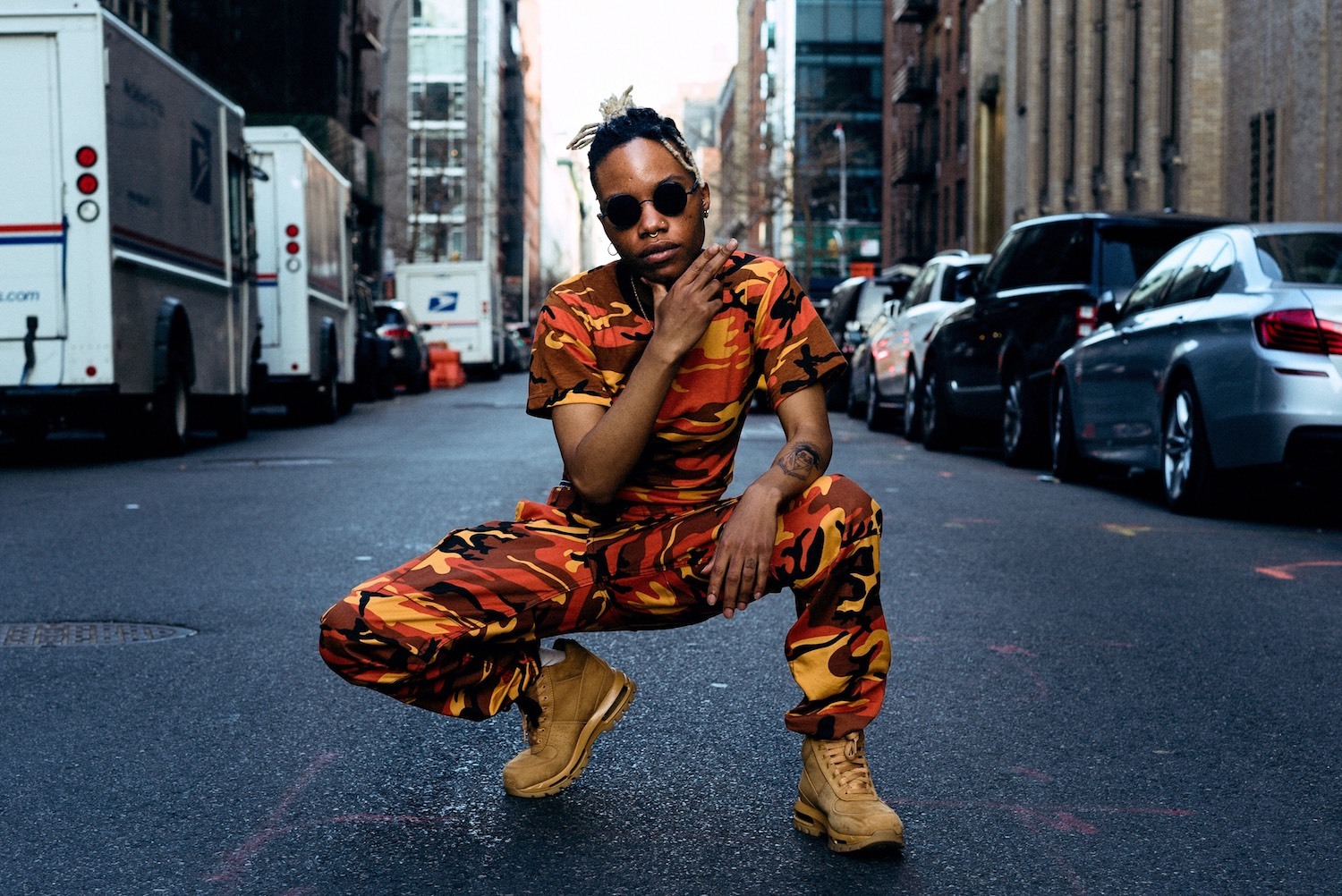
Top billing at club nights might still go to white dudes, but the future of electronic music looks and sounds a lot more exciting — at least in Brooklyn. A community of DJs and producers in the outer borough have long been carving out safe spaces for queer and trans artists of color. Their M.O.? If you don’t put us on, we’ll find our own place to play. From inclusive collectives like Discwoman and Papi Juice to local beatmaker Tygapaw’s underground club night Fake Accent, New York’s most innovative artists are channeling the struggles of marginalized people into cathartic community experiences.
Not all of NYC’s most innovative artists were born and raised in New York — Tygapaw’s Fake Accent parties were born from her unique struggle as a Jamaican immigrant, while Discwoman-affiliated DJ Bearcat hails from Brixton, London. The dynamic deck queen’s mixes are as wide-ranging as you might expect from the birthplace of David Bowie, Big Narstie, and The Clash. On 2016’s “Charged Up — Sandy Speaks” she layers a haunting soundscape with Sandra Bland’s profound words on racial injustice. Tygapaw has sampled Eartha Kitt and dancehall alongside Top 40 hits by t.A.T.u.
At Sugar Hill Supper Club on Sunday, Red Bull Music Academy’s “A Bed-Stuy Function” will bring together the neighborhood’s most experimental collectives and DJs, including Bearcat, Tygapaw, Juliana Huxtable, Papi Juice, and KUNQ. i-D talked to Tygapaw and Bearcat about sampling powerful women and navigating nightclub politics.
What do you like about playing community-focused parties as opposed to clubs?
Dion (Tygapaw): Community-building is so important. Especially within the LGBTQ community, because a lot of us are displaced in some way, shape, or form. It can be very isolating by yourself. A lot of spaces have a lack of consideration for individuals within a space. I’ve played at certain clubs in Manhattan and been held at the door for 20 minutes. That should just never happen.
Kerrie Ann (Bearcat): I’ve been there so many times. In Barcelona I’ve been standing under my name arguing with people to get in. It’s definitely a thing that happens a lot, and it’s definitely a thing that happens to black women, for sure. It’s almost as if people can’t believe that you are the DJ. It’s not ingrained in their psyche to digest that so they question it all the time. It also doesn’t set the tone for the rest of the night. What kind of set are you going to bring when you’ve been treated like that?
Dion: I have many, many male DJ friends and they’re always respected. An actual publication that I DJed for, the person was setting up my set and cutting the sound out. I’m perplexed on a daily basis here in New York.
Kerrie Ann: We have to deal with all the pain. There have been moments when I want to give up because there has been violence or really risky things that have happened when all I’m doing is showing up and doing my job. I played with DJ Minx, a black woman from Chicago who has been doing this for 30 years and pioneered the way for us, and the stories that she told me — you can just imagine 30 years ago. I think next Sunday is going to be amazing. We’re already a strong community but I’m excited to see if we can attract local people from Brooklyn as well. We’re definitely here to provide a service, not only for the LGBTQ community but for the original community.
Kerrie Ann, you mentioned Barcelona. Dion, you were talking about your experiences in Manhattan. Do you feel like it’s the same wherever you go regarding gender and race-based discrimination?
Kerrie Ann: It’s really all the same. At the gig in Barcelona the club was absolutely humongous, DJ Spin was playing the same night and there were maybe five rooms. We were put into the “hermanas” room, the female DJ room. The hotel DJ Haram and I stayed in was predominantly for DJs, and we were treated like sex workers. Being brown women there, people could not digest it. In racist countries they’re pretty honest about showing it.
Dion: I haven’t played in Europe as much as Kerrie, but I’ve heard about experiences like hers. I’ve been booked at certain places that I don’t want to support because of how they’ve treated one of my sisters.
Kerrie Ann: But then you shouldn’t miss the opportunity. It’s difficult and it’s political.
Dion: The Nina Simone documentary empowered me to know that sometimes my beliefs and integrity can hold me back sometimes. Particularly in a city where no one gives a fuck about each other, I often feel like I care too much. It’s important to meet good people and come together in solidarity to say “we’re not going to support that place because their beliefs are racist or anti-LGBTQ.”
How does being women of color affect people’s expectation of what they’re going to hear you play?
Kerrie Ann: I’ve played at venues where they think I’m going to play Mary J. Blige and R&B soul all night. Or they’re like, “Can you play all rap?” I cross over every genre in a set, I can’t even describe my sound to you — it’s just everything. So that definitely happens for sure.
Dion: Same here. Being Jamaican and needing to play dancehall during every set — I just squashed that immediately. I grew up in a very weird way in terms of being an artist and not knowing that you’re an artist. When you’re a child and you’re in America you often have opportunities to go to schools that are arts-focused. None of that exists in Jamaica. It was difficult just to wrap my brain around why I was so different, so I really dove into alternative music when I discovered it. I just loved hearing distorted guitars. Distortion is disturbance, and I was feeling very uncomfortable in that space because I never felt like I belonged there. Black people need to be given the benefit of the doubt that we’re complex people. It’s like if you’re black and listen to alternative music, you’re white. Or you’re a weirdo.
Kerrie Ann: You’re a coconut, or an Oreo. Black people are only supposed to be one thing, and it’s ridiculous.
Dion: I don’t know if you get this Kerrie, but I’ve been getting this a lot lately. People hear Tygapaw, and if they don’t know what I look like, they think I’m a white nerdy dude. I introduce myself as Dion to people, and when I explain that I’m Tygapaw, they’re so surprised. Why couldn’t this come from me, or Kerrie?
Kerrie Ann: I’ve had that from people in our community, who are people of color and queer and have been like, “You’re Bearcat?” The ideas are not exclusive to one type of person. There’s work to be done everywhere. I don’t really believe in safe spaces, but I truly believe in working towards them.
Kerrie Ann, you recently incorporated spoken word into a track with words by Sandra Bland, but powerful black women in general can be heard in much of what you create. What makes music a good medium for these voices?
Kerrie Ann: The sampling stuff that I put out on SoundCloud, I don’t really consider it my music. As much as I’ve created it, it’s more of a piece that’s spoken word, like you said. It resonates with me so deeply that I have to produce a beat to go with it to make it melodic. Sandra Bland goes without saying, but there’s also Dina G. Carter, who went off at this pervert on the train. It was so empowering to hear this woman say all the things that so many women wish that they could. We’ve all been there, we’ve all had that guy stare at us too long, we’ve all had those predatory moments.
Dion: I try to put a lot of powerful women who inspire me in my mixes. In my intros I’ve used Eartha Kitt…
Kerrie Ann: Same! We both did that.
Dion: A lot of us can relate when these powerful black women, our ancestors, speak. They’ve lived a life before us. We carry that torch. We’re also leaving these archetypes for the next generation.
Kerrie Ann: At the time they were probably overlooked. [Kitt] had the CIA coming for her and all this kind of nonsense. It was crazy. Music can honor these women. These women need to be heard. If I can create a soundscape that can make people more intrigued… that Sandra Bland track I did has had over 15,000 listens. What she’s saying on that needs to be heard. Her legacy needs to be carried on. It’s deeply personal for both of us when we are sampling. It would be easy for me to sample something cute and make a club hit, and I’m sure I will do that. But I haven’t had it in my gut to do it.
Dion: People are so afraid to be vulnerable in music, and that’s what we have to get back to. Sam Cooke when he wrote that song “A Change Will Come,” that was necessary for that time. He wrote that out of pain and struggle. And Nina — Nina writes all of her music from pain and struggle. Music is one of the most powerful tools to change shit if you really let it. Pop music is dope, but it’s not what it was when I was growing up in Jamaica listening to Tina Turner, Whitney Houston, Phil Collins, Celine Dion, Michael Jackson, Prince. We’re losing a lot of the pop music that means something. That’s why I sample from older records. That music resonates to this day and it’s important to keep it growing through sampling.
In her “Sandy Speaks” videos, Sandra Bland talks about the All Lives Matter Facebook trolls. Your own online communities, on the other hand, have a very positive vibe. How important is it to create an inclusive online space?
Kerrie Ann: I think it means a lot to that person who’s in the sticks and has no access to anything to see the visuals of us doing our thing. I remember how the internet affected me like that and inspired me to get where I am now. Dion and I created the Sistren [Facebook] group, a space that’s not exclusively for women of color, but there’s a focus on women of color there. If you’re a white guy with one friend then you’re not going to be accepted, but if you have mutual friends with other people and seem like you’re involved with some kind of music — it doesn’t have to be DJing, I encourage people like managers, promoters, videographers to all be in that group. Seeing the visuals of other people doing what they’re doing — it plants a seed. If you really want that you can start working towards it.
There has been a lot of discussion about the future of dance culture in light of the election, Fabric closing, and the fight to repeal NYC’s cabaret law. How do you feel about the future of inclusive dance scenes in NYC?
Kerrie Ann: I personally feel good about it. Manhattan isn’t ready to digest us. Manhattan can digest maybe people who look like us but who are not playing what we play. Our sound isn’t mainstream enough. But in Brooklyn I do live in a bubble, and I appreciate that I’m surrounded by so much incredible fem and non-binary talent. We’re all out here doing our thing and creating visibility. What’s happened recently has made us more hungry and more aggressive about getting where we need to go and speaking out about what we need to say. That’s not to say the future isn’t scary. It’s a very uncertain time but our ancestors have survived worse.
Dion: In the long, long run, I don’t know how everything looks in NYC. From when I came in 2002 to when I’m living here now, it’s shockingly different. Spaces are disappearing at a rapid place, and it’s like, “Where are we going to go?” We’re being pushed more and more to the east it’s not sustainable for anyone who’s low-income, or not rich. Even the middle class, I don’t know what that looks like any more in New York. The music that we do and we play is in response to how much things have been changing so much and displacement is happening at such a rapid pace for marginalized communities.
That’s an important point. Is this displacement thrown into higher relief for you as an immigrant?
Dion: Definitely when you’ve migrated and come to a new country — the immigrant story is so real. It kills me to see what’s going on in the world today. It’s so hurtful. The reason why I’m here and in this place now is that I’ve had the opportunity to come here and make something of myself that would be really impossible if I stayed in Jamaica, being queer and open, I wouldn’t have been able to come out. Immigrants are not criminals, they’re the most low-key people. They just want to make a better life for themselves.
Red Bull Music Academy presents “A Bed Stuy Function” on Sunday, May 7 from 2-10pm. Tickets are $10 and available here.
Credits
Text Hannah Ongley