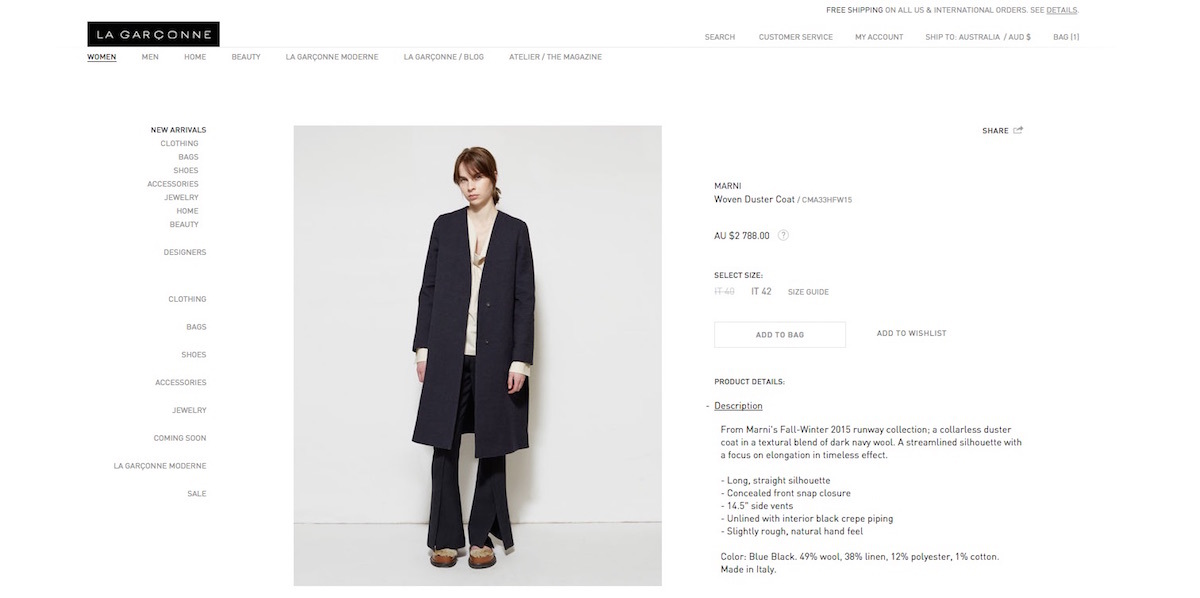
When e-commerce first arrived some twenty odd years ago, plenty of naysayers were certain that it would fail. In fact, when Natalie Massenet founded Net-a-Porter in 2000, people told her she was crazy. Now in 2015, we could hardly imagine a world without online shopping. Not only has online shopping dramatically changed our consumer habits, its ripples have also been felt throughout a number of different sectors. Take Australia Post, for example, who recently announced that parcels had now become their major moneymakers for the first time ever.
In Australia, some would argue that the impact of online shopping has been even greater than in other parts of the world, not least of all because we are situated so damn far away. Gone are the days when product costs were hiked up to well above the original retail price — encompassing all manner of hidden costs. But back then we would have begged a travelling family member to bring home a Sephora haul at just a fraction of the cost here at home. Since then, online shopping has totally changed the game and, in the process, forced many local retailers to reduce their prices in order to stay competitive.
Now we seem to be facing something of a time warp though, as the Australian Government prepares to implement new GST regulations from 2017. Where we haven’t previously paid GST on products bought online and under $1000, that low value threshold is about to be eliminated altogether. In other words, from July 2017 all products purchased online will be whacked with an additional 10% in GST surcharges. But there is a silver lining. What seems like bad news for consumers should actually prove beneficial for our local retailers, who have claimed for years that the $1,000 threshold makes domestic goods uncompetitive. A boost in the retail sector would undoubtedly do wonders for our economy, but many local shoppers remain sceptical. The secondary silver lining here is that it should also prove quite difficult for the government to uphold these regulations, given that it requires both increased border inspections and the cooperation of foreign companies — who are in no way obliged to pay Australian taxes.
So what does this really mean for the future of online shopping, then? Well some believe that this GST move will only serve to encourage local consumers to favour smaller websites over their larger counterparts, in a bid to avoid the 10 per cent tariff. Perhaps more local retailers will up the ante when it comes to their own e-commerce platforms, too. Still to this day, a lot of Australian e-tailers are being developed offshore — especially in New Zealand — while our major department stores are worlds behind the likes of Barneys and Saks when it comes to e-commerce sophistication. But all of this could be set to change.
Certainly, new technology has already been developed to bridge the gap between consumer behaviours both online and in traditional brick and mortar stores. And according to Forbes Magazine, the pace of e-commerce growth has actually been decelerating worldwide. Although online shopping is still experiencing some growth, the numbers are definitely on the decline when compared to a couple of years ago. And this suggests that the bulk of the e-commerce boom might now be behind us. In fact, some projections even suggest that traditional retail stores might end up being those that prevail. Not least of all because most retailers have developed their own online sales strategies since the online shopping boom first began. Traditionally, though, this concept hasn’t worked in the reverse. Major e-tailers like Amazon and eBay, for example, are still yet to launch physical counterparts.
With this in mind, a lot of larger retailers have now begun to consider location-based technology. In other words, they are catching onto the fact that, for e-commerce platforms, it has always been quite easy to gather data about their customers. Now brick and mortar stores want to adopt that same approach in order to maximize sales. Back in 2013, Apple released their iBeacon product, which tracks customers via their phones and can even send them a push notification once they walk into a store. So if department stores can see plenty of foot traffic happening over in swimwear, for example, but don’t have the sales to reflect this, then they can send customers a push notification to alert them of 10% off swimwear in order to close the sale. While all of this sounds a little daunting, it could present a more targeted shopping experience for us all.
In the opinion of fashion’s e-commerce Godmother, Natalie Massenet, the future will certainly see a more personalised consumer experience. On one hand, she believes that fashion will become even more exclusive, with a focus on bespoke, slow fashion. But on the other, she imagines not fast fashion, but more personalised fashion. In other words, she envisions a world in which designers will be able to create based on individual consumer needs. This is what her app, The Net Set is all about really — merging what people ‘like’ (social media) with what they can buy (e-commerce). And in many ways, this makes sense. We are all so tied to our phones today and it is no secret that a few strategically placed Instagram images can go a long way to shifting product. But now that location based technology could allow physical stores to implement a similar strategy, perhaps the worlds of online and traditional retail will need to start working together more seamlessly.
Some of the biggest and most successful companies of recent years have been built online; only later to transition into physical stores. Take optical giant Warby Parker, for example, or Emily Weiss’ beauty brand Glossier, which has just wrapped another of its many pop-ups, this time in New York. Is this symbiotic relationship between digital and physical the most productive marriage for the future? Either way – between proposed GST changes and technological developments allowing retailers to tap into our personal information — there certainly does seem to be further change in the air. And if Massenet is right, the future of online shopping could be looking a whole lot more niche. The only question that remains, then, is at what cost to our privacy? To that, it seems, only time will really tell.
Credits
Text Rosie Dalton