written by MATHIAS ROSENWEIG
Moscow native Lena Katina seems worlds away from her past. Now in her forties, twice married and a mother of two, she has a confident and carefree way about her. Her fiery red hair, though, remains the same. “At 19, you’re still a teenager, and a teenager’s mind thinks differently,” she says over Zoom from her hometown in March of this year. “Scandals and being provocative and being different are the most important parts of being a teenager. Of course, I was enjoying it. Of course, I was having fun.”
As a teenager, Katina was one-half of t.A.T.u., a band that courted scandal with rebellious attitudes and provocative teen sexuality. The band, which was originally meant to be a solo artist project focused around Katina, was developed by a then-33-year-old Ivan Shapovalov, a child psychiatrist and wannabe music producer. Four hundred girls reportedly showed up in Moscow to try out for his unnamed musical project in early 1999, and Katina was one of the 10 finalists. Katina recalls Ivan driving to her apartment to talk. “He was like, ‘There’s this LGBT community, and they really have a tough life because people judge them. They prohibit them from loving who they want to love. I want to bring this topic to the public so that these people won’t feel alone.’”
At the time, Russia had still not passed its anti-LGBTQIA legislation, and was still relatively friendly to gay people. That changed in 2013, when the Russian government effectively made it illegal to distribute “propaganda” to minors that positioned queer people as equal to heterosexuals.
Shapovalov asked Katina if she’d be willing to turn the project into a duet, as well as what she thought of Julia Volkova, with whom Katina was previously in a children’s choir, Neposedy. Katina remembers saying, “We’re friends. I don’t mind at all.” But both girls hadn’t fully wrapped their heads around what Shapovalov was insinuating: that the duo would be somehow promoting the queer lifestyle. “I mean, we weren’t together,” Katina adds. “I had never had a lesbian relationship in my life.” She’d hardly had any romantic relationships. “I was 15 years old. What can you understand about life when you’re 15?”
How exactly the faux-sapphic stars aligned depends on who you ask, but in between Shapovalov watching Show Me Love––director Lukas Moodysson’s film about two Swedish school girls falling in love––and music producer and writer Elena Kiper having a lesbianic vision, the concept for t.A.T.u. was born. “She had a dream where she was kissing a very popular TV host at the time, and she woke up with the words ‘Я сошла с ума’ [Ya Soshla S Uma],”—the title of the original version of t.A.T.u.’s breakout hit, ‘All the Things She Said’— “which means, ‘Oh my God, I’ve gone crazy,’” Katina says.
The music video featured the 15-year-olds wearing what became their infamous signature look—schoolgirl uniforms—standing behind an ominous metal gate meant to summon imagery of Nazi concentration camps, kissing in the rain as onlookers watched disapprovingly, drenched in wet white button-downs, and begging their parents for forgiveness after falling in love with a girl. “We didn’t know that we would kiss,” Katina recalls. “We thought Ivan was joking.”
Russian radio refused to play it initially. However, the video became an immediate sensation on Russian MTV, spreading like wildfire around the world. They reached the top of the charts in the United Kingdom, Germany, Austria, and more––making them Russia’s biggest pop cultural export ever, an accolade they maintain today. (“All The Things She Said” was recently featured in the Academy Award Best Picture Winner Anora and is the theme song for the edgelord podcast Red Scare.)
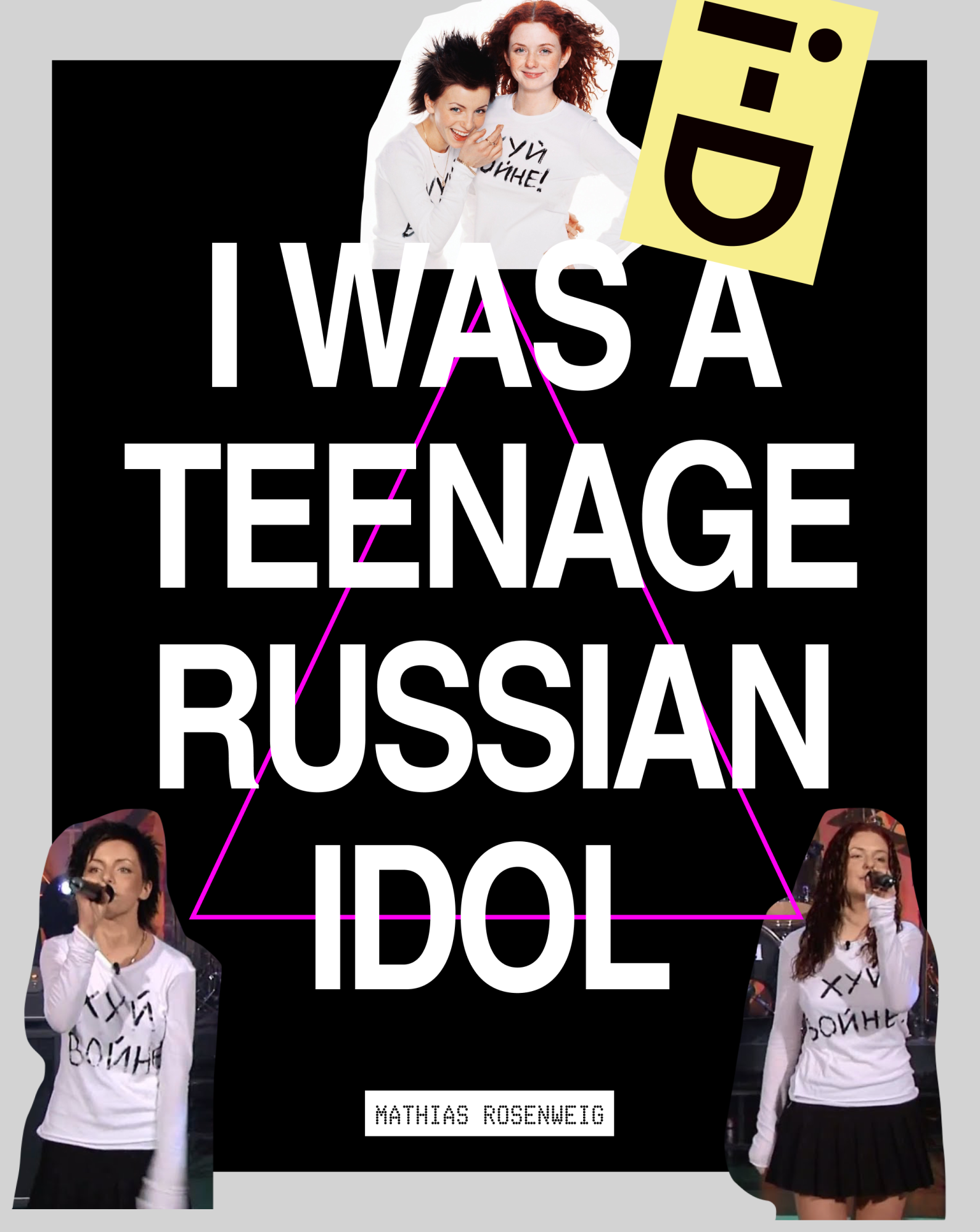
In February of 2003, t.A.T.u. performed on Late Night With Jay Leno wearing shirts that read “Fuck War” in Russian, protesting the United States’ invasion of Iraq. Lindsay Lohan and Rachel Dratch impersonated them for a skit on Saturday Night Live. Their debut English album, 200 km/h in the Wrong Lane, was certified gold by the RIAA. With their success, t.A.T.u. helped usher queerness into the mainstream, even beating Madonna and Britney Spears to a lesbian kiss on MTV. “We were first,” Katina says proudly.
“It gave me an absolutely whole new life,” Katina says. “It was my dream, which came true, actually. I never expected that I would be a famous singer,” she adds, recalling working with artists like Sting and Trevor Horn. “We were the first from Russia to become that big. Every day you wake up and think, ‘Oh my God, this is not a dream.’”
The dream, though, became something of a nightmare. Also in 2003, in the self-made documentary Anatomy of t.A.T.u, they officially came out as straight. Volkova admitted she was in the very early stages of pregnancy with her boyfriend’s child, while Katina spoke about wanting to build an orphanage and talking regularly with her priest about what she does on stage. “I kind of want to repent for my sins,” Katina tells the camera. “What I’m doing right now is a really big sin.” The blowback was immediate and severe. Controversial already, many of the band’s supporters—the queer communities across the world for whom out-of-the-closet pop stars meant everything—turned on them. Deceitful? Yes. Immoral? Yes. But with a groundbreaking impact? Yes.
The controversy masked a troubling reality behind the scenes. In a 2023 interview with Russian media personality Ksenia Sobchak, Volkova discusses performing at “corporate parties” in the early 2000s, meaning gatherings typically thrown as a part of organized crime rings, in which sex trafficking, drugs, and mafiosos regularly mixed with the Russian entertainment’s elite. She recounts a story in which, after the girls performed, the “businessmen” told their management to go home and leave the teens on their own. “Our manager said, ‘Do you realise they are 15, 16 years old?’” she recalls. “The man was like, ‘There are always oral methods.’” After hinting that their bodyguards would have been helpless against these men, Volkova says management was able to get them out unscathed.
She goes on to talk about filming the music video for “A Simple Motion,” in which Shapovalov asks her, at the time just 17 years old, to masturbate on camera. “Relax. Call somebody, listen to someone’s voice. Do it!” she recalls him saying. When asked about the morality behind this, Volkova says it was nothing compared to other experiences. “We had earphones in during a concert in Japan. He said, ‘Before ‘A Simple Motion,’ sit down in front of 50,000 spectators and put your hand into your jeans and start masturbating.”
“Ivan brought us to fame,” Katina says of Shapovalov’s proclivity for creating scandals. “Why wouldn’t we trust his judgment?” But as far as the trauma and difficulties they faced as teens? “Kids,” Katina starts, before continuing firmly, “you know, they grow up.” She’s still very proud of t.A.T.u, and with good reason, continuing to perform the hits regularly today (but only singing the gendered parts in English—her attempt at staying safe under current Russian law). Despite it all, the band did have some positive effect on queer visibility not only in Russia, but globally. Katina, still very much considered a gay icon in her motherland, says, “You have no idea how many different letters we got with ‘thank yous.’ Like, ‘Thank you, girls. You saved my life. I was on the edge, and now I realise that I’m not alone in this world, that, you know, nothing is wrong with me—that I’m just different.’” People were telling her that t.A.T.u. had saved their lives. Realising that she was making people feel less alone, even if it was a gimmick, was comforting to Katina. “It wasn’t about me. But I realized, ‘Okay, by doing this, we’re helping others.’”
That said, it took friends and family to bring her down to earth after the group’s explosive success. “All of this fame, which came so suddenly to us, of course, it can’t just pass you by,” she says. “We started to feel like stars. We [were] super important, VIP. You expect people to look at you a certain way, and if they don’t, then you’re like, ‘What the fuck?’” After a pause, she adds, “But the most important profession is being a person.”
I Was A Teenage Russian Idol
Twenty-five years after t.A.T.u.’s faux-lesbian schoolgirl act shocked the world, singer Lena Katina reflects on its complicated legacy.
Loading