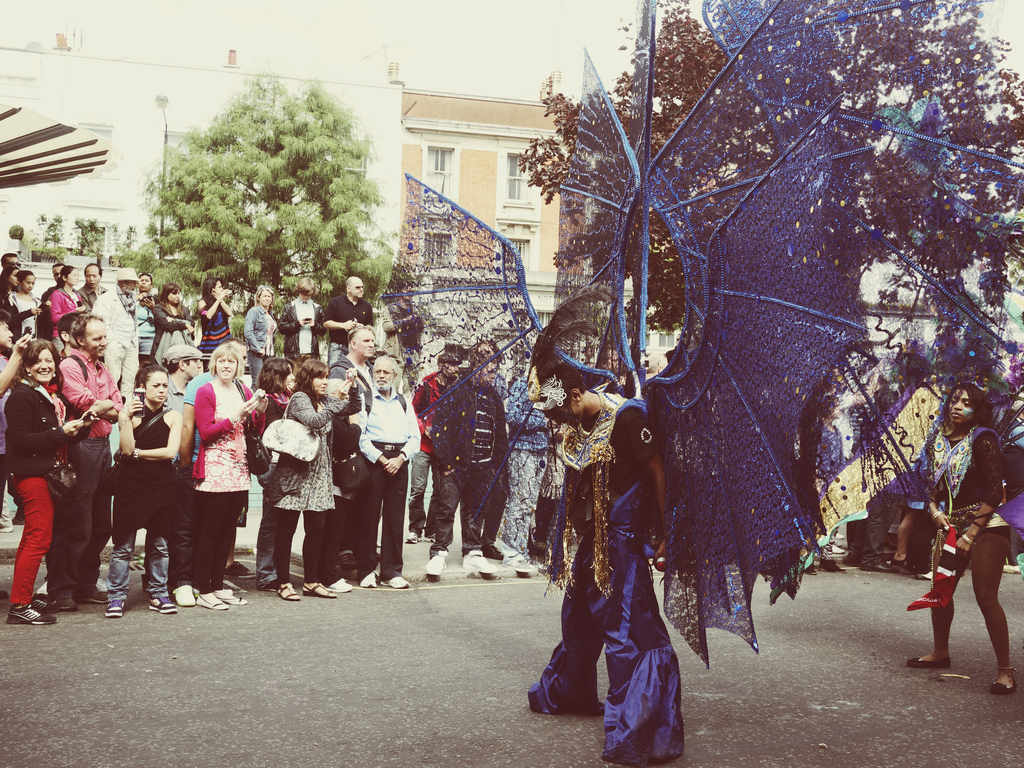
For me there is the Notting Hill Carnival I experienced as a kid, going on Sunday — which was dubbed children’s carnival day — as opposed to Monday. I remember the noises and the colours, the hot sun, but more often the pouring rain, and most importantly the sound of the steel bands. Then there were my teenage years, playing mass on my cousin’s band, doing the “jump and wave” with a Trinidadian flag from our float as we manoeuvred around the streets. Then when I was too cool for that, it was about running through the streets to get to the Rampage Sound stand as quickly as possible where my mates and I would stand for hours, listening, dancing and catching up with everyone we knew, at this our unofficial meeting point.
Depending on your relationship with Notting Hill Carnival, it’s either simply its tagline “Europe’s largest street festival”, something to visit once and take pictures, or it’s so much more than that. To those who grew up in London, those who play on the stages and those who have been hanging around sound systems for as long as they can remember, Carnival is that one party you always make sure you’re here for.
“For us it’s like the whole rest of the year is a warm-up for carnival’, Benjamin D from The Heatwave tells me. Benjamin set up Heatwave with DJ Gabriel Heatwave hosting events and parties that bring dancehall and bashment back to the rave scene. “For us Carnival is prime time, it’s like Christmas, it’s the ideal crowd — a home crowd. We spend a lot of time playing bashment to crowds around the world and they might not get it, so you have to turn them on to it. But when you get to carnival everyone knows wha gwan, they are fully on board with the tunes and ready to dance,” he adds.
Whether you like reggae, dancehall, bashment, UK garage, grime or drum ‘n’ bass you’re guaranteed to hear a snippet of all these sounds at some point across the 20-mile, two-day festival, where the streets are lined with speakers and discarded whistles. It might not have the glamour of Rio or the guaranteed sunshine of Trinidad, but it stands out for the vibrancy, the diversity, and the cheesy YouTube videos of police whining with calypso dancers, dressed in feathers and beaded bras. And it brings west London to a standstill every year.
“You can dance how you want and dutty wine without anyone giving you any looks,” says 1xtra DJ Jamz Supernova on why Carnival has such a place in her heart. “It’s about the fusion of culture, Caribbean culture being the main running theme, but it’s also welcoming to everyone, you don’t have to know anyone or even know the songs to have a good time.”
It’s also steeped in history, Notting Hill Carnival started during a time where to be black in west London was dangerous, the 1958 race riots had taken place just a year before the Carnival was started. So for many black immigrants to jump up to calypso, soca and reggae was not simply a chance for a party, it was a political act, a celebration of their identity, standing defiant against racism, and that’s not lost on us who party now.
“When you go to Jamaica or any of the small islands, they are such small places but you realise that they have had and continue to have such an impact at the Notting Hill Carnival and around the world, from language to clothing, music and food. It’s amazing that they came over across on the Windrush ship from the Caribbean and created the biggest outdoor European festival. That’s an amazing legacy, I feel so proud. It’s the one time of the year that everyone boldly claims his or her Caribbean heritage. I was like, ‘I need to go buy my Jamaican flag for Carnival'”, says Jamz Supernova.
For me, Notting Hill Carnival has grown with me, it is the backdrop to summers in London, a reason to get dressed up, to hear some of the biggest tracks of that year, to drink Red Stripe in the sun. It has also changed a lot. Over the last ten years alone, it’s become even more wonderfully multicultural, the musicians have changed, the route map has changed, and the whole festival seems to go through a new incarnation each year.
This year, because of a mixture of regeneration, building work, overstretched police resources and health and safety concerns, some of the classic static sound systems including Norman Jay’s Good Times have either been unable to secure a spot, or retired. Last year, the iconic Channel One Sound System, which has played at Carnival for over 20 years, got caught in a licensing battle with the council. The DJs were told that they couldn’t perform without a new licence, which reflected the huge crowds they brought in, but thanks to a council meeting and online petition – they were eventually able to play.
Bryan Mclean who rigs up sound systems and is part of the Dirt Sound System has been going to carnival since 2004, and he’s seen how the changes affect the musicians on street level. “I’m a huge fan of the old reggae sound systems – people like Channel One. When I was growing up we would look at them in awe, they went around with their speakers and looked like they were having a whale of a time, just making people happy. We’ve lost some outstanding sound systems — Sancho Panza and Rampage aren’t there this year to name a few. The thing is that there are spots available but I know how hard it can be to get them. I myself tried for ages to get back on the street after doing floats for a few years and I’ve managed it this year, but it was hard,” he says. Yet, despite the challenges he comes back every year. “It’s opened up my mind to so many different sounds. I love coming back from carnival, I always leave with my pocket full of Soca CDs that I’ve stolen off the DJ”.
Carnival has also become so popular that you’re just as likely to see Cara Delevingne there as you are to see Damian Marley. But, while the crowds have changed and grown, and some of the old favourites aren’t there, each year offers another reason to enjoy Carnival. “There’s nothing like it. Not to be too romantic, but every year I go back and remember why I feel in love with it. Come rain or shine. In fact last year, Carnival Monday was sick in the rain, it brought out a different energy – just so many people dedicated to celebrating every minute,” says Benjamin D.
Credits
Text Carlene Thomas-Bailey
Photography Eli Epstein