Our favorite writers muse on their muses for our “My i-Con” essay series. From Grimes to Grace Jones, read every heartfelt ode to personal style here.
I have no style icon now. I am cultivating a look this winter that no one has noticed or at least commented upon: full Amazon Prime from head to toe, comprised of American heritage brands like Champion, Levi’s, Hanes and Fruit of the Loom. Sweatpants are usually involved. But everything HAS to be Amazon Prime, meaning free shipping. And this is topped off with a fashion coat, like this Jil Sander midnight blue shearling that looks deceptively like a cheap pimp coat from Amazon Prime. Soon, I’ll hear: “Well, it looks like you got that whole outfit without trying it on or paying postage!” But like most folks, as a teenager, I certainly had style icons.
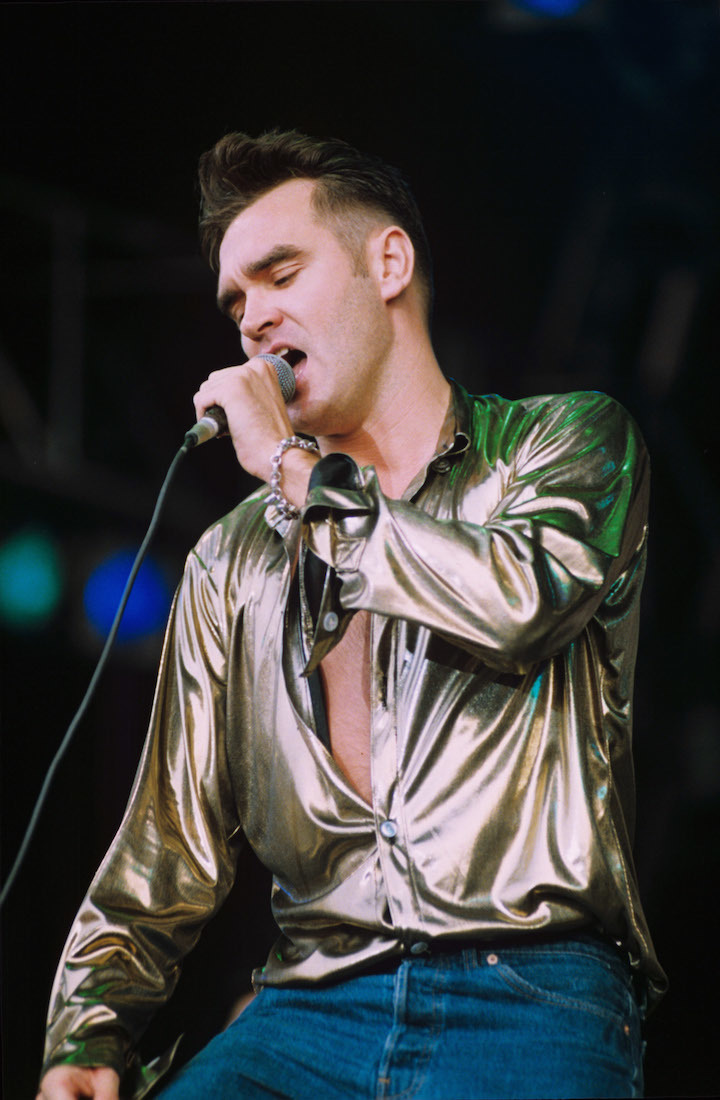
In 1992, Morrissey was on his mince of triumph across the United States for the Your Arsenal tour. The rockabilly-band-goes-glam album was the American chart hit that eluded The Smiths. Each night he’d wear a shiny button-down shirt, silver or gold, and it would invariably be ripped off by either the crowd or himself — or he’d just fasten the bottom two buttons and leave it open like a slut.
I don’t know if he was vegan or just vegetarian at this point, but there was no body fat. His look was a fraction more butch than the “November Spawned A Monster” video that Beavis and Butthead made fun of. There was a wonderful schism between the hard music and his fey insouciance as he lashed the microphone cord like a whip. It was both erotic and sexless, and per usual a lot of singing about feelings and not fitting in – perfect for any adolescent. A group of us drove from our small Kentucky town to see his show at Nashville’s Grand Ole Opry (spiritual home of Minnie Pearl and Morrissey).
Zima had just come out, a now-discontinued repulsive clear beverage that was part of the Crystal Pepsi and other clear drinks trend, but with alcohol. The show is tragically not on YouTube because my 15-year-old self would be seen climbing onstage and hugging Morrissey. I imagine it was in the middle of “Tomorrow,” where he dramatically sings, “Oh, the pain in my arms” and turns his head and pouts, “Oh, the pain in my legs!” but I have no clue about when our embrace occurred because I was so shitfaced. The guards removed me from Morrissey like a tick and ejected me into the parking lot. I vomited some Zima and walked back in.
I was a sexually confused high school student who had no clue I was sexually confused. Today, every TV commercial features heteronormative multi-denominational gay mixed-race couples, but in the early 90s there were no cool gays in pop culture except for Scott Thompson of Kids in The Hall, who is an unsung trailblazer. The reality that a gay world was out there didn’t exist in an isolated small town. The only way to express unrealized gay feelings was by being besotted with the sexually nebulous: Morrissey — and the Alexis to his Krystel, the Crystal Pepsi to his Zima – Brett Anderson of Suede (who projected a more femme image but is totally straight). There was also the component of their English otherness. Their music meant so much to me, and so did their respective styles.
In 1992, Suede had yet to release their debut album but they had two amazing singles out with B-sides better than the A-sides (similar to The Smiths’ M.O.). And they were all over the British music weeklies, NME and Melody Maker, which I’d read religiously. Anderson would always have queeny proclamations like, “I’m a bisexual who’s never had a homosexual experience.” Morrissey was an early Suede fan and on the Your Arsenal tour covered “My Insatiable One,” which had the shocking refrain “He’s my insatiable one.” But they’d shortly thereafter queen out on each other in the press with Morrissey issuing the witheringly funny, “He’ll never forgive God for not making him Angie Bowie.” I don’t know what he meant by this but it amuses me thoroughly.
I was infatuated by Suede and Morrissey, and I compartmentalized them together. I attempted to present an amalgam of them. I had no access to silver lamé shirts (what brand were they? They need to be in some exhibition. I’m sure a pilfered one is framed and on some sensitive homosexual’s wall).
I had long bangs like Anderson and a leather jacket, Morrissey’s sideburns, but this was Kentucky and pre-Internet so I didn’t know how to fill out the look. It was invariably rounded out by waterproof hiking boots (we hung out in a lot of fields to get drunk or drive trucks in circles in the mud) and it was the 90s so plaid factored in a lot. Morrissey and Brett would not have approved. Anderson had a charity shop prostitute vibe, and would often wear lace midriff-exposing women’s blouses, but I wasn’t interested or brave enough for androgyny that highlights a problem area on your body. I opted for mail-ordered Suede T-shirts. My favorite depicted a pig in a business suit yanking its own ears. I still wear it in summers, the sleeves have since been cut off and the collar is frayed and split in two. My senior quote in the yearbook was dramatically taken from Suede’s debut album, “See you in the next life, when we’ll fly away for good.”
We’ll be rolling out stories by our favorite writers on their personal style icons all week. Read them all here. Who’s yours?
Credits
Text William Van Meter
Photography Brian Rasic/Getty Images