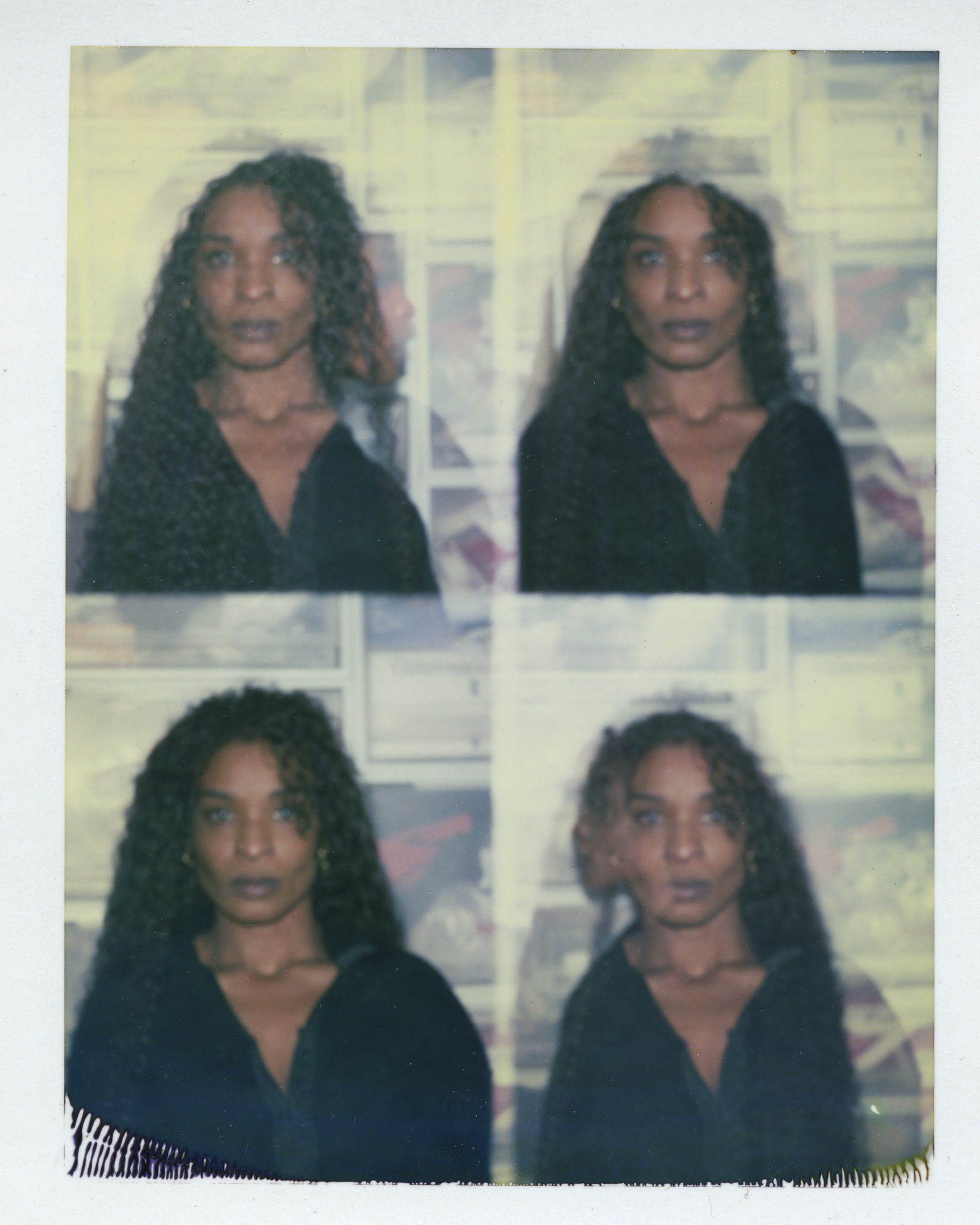
This story appears in i-D 376, “The Lore Issue.” Get your copy of the print magazine here.
written by ALEX KESSLER
photography SARAH STEDEFORD
In the gilded halls of the Shangri-La, to the sound of Naomi Campbell’s footsteps cutting across the parquet, Torishéju Dumi arrived on the Paris fashion calendar. A sole seamstress helped her construct the garments. Gabriella Karefa-Johnson styled the show. Editors came because they were told they should. Buyers stayed because the work held. The debut resisted spectacle, even as spectacle surrounded it.
These clothes did not behave like a first collection. They were considered and restrained, already in possession of their own logic. Tailoring curved where it should have resisted. Silhouettes pushed outwards, then snapped back under control. Menswear was not an aside but a proposition: disciplined yet surreal and central to the world Dumi was starting to create. By the end of the show, attention firmly settled on the Brazilian-Nigerian designer from London, whose work offered little in the way of explanation. Just as quietly as things began, something clicked into place. Adrian Joffe asked Dumi to meet. In a rented studio near her flat, she laid the collection out piece by piece. There was no pitch. No performance. “We talked about life,” she recalls. “We cried.”
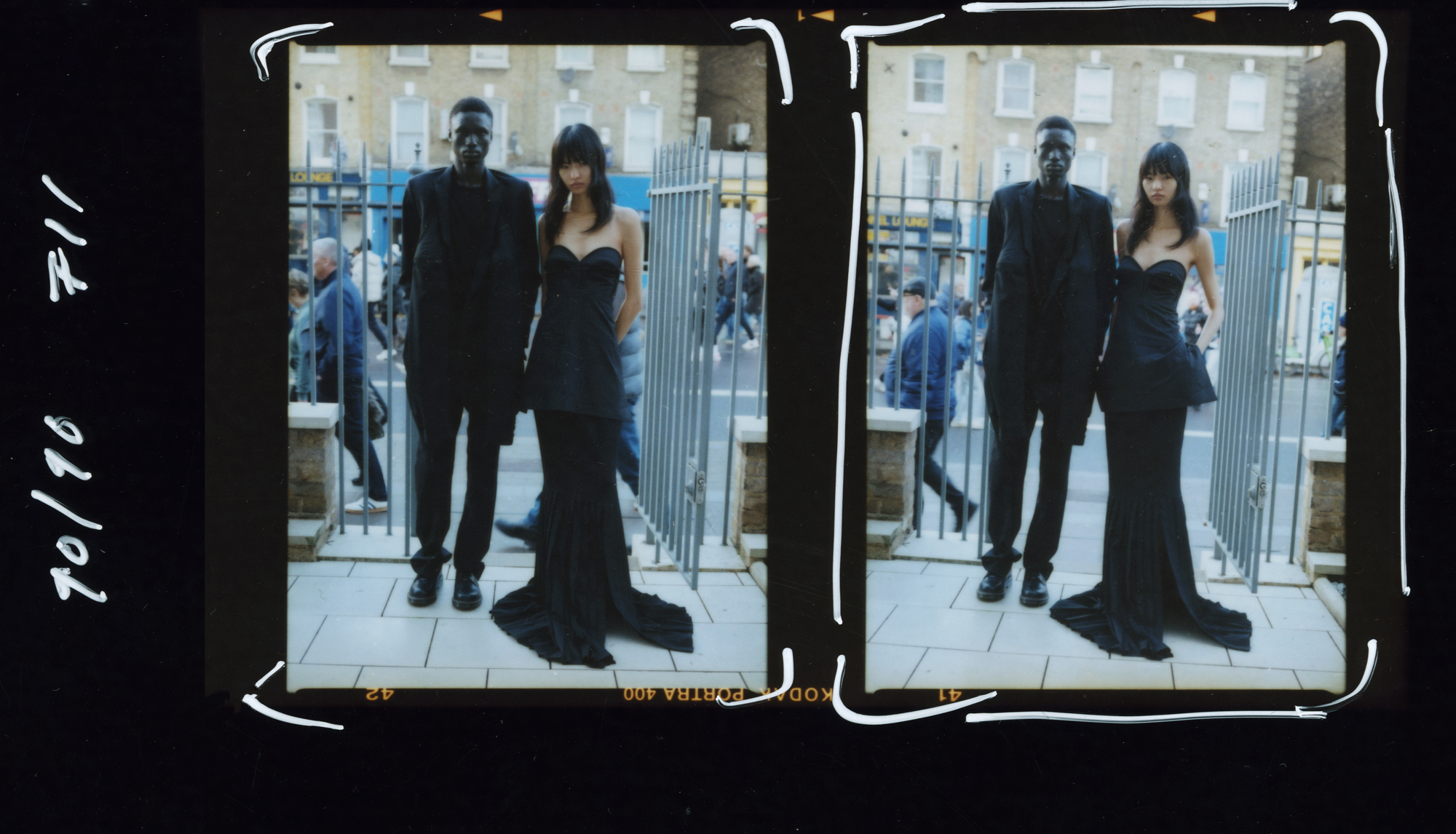
When Joffe asked how he could help going forward, she didn’t hesitate. She wanted to be in Dover Street Market. Shortly after, all DSM stores bought the collection. No surprise. “It was the beautiful tailoring that attracted me most at the beginning,” Joffe says. “She had no operations. It was just her. But her collection blew me away—as did her passion and her faith.
What followed was work. Relentless, unglamorous work. “I did everything myself,” Dumi says. Barcodes. Packaging. Distribution. “It was awful, but I did it.” Steadily, in came the recognition. Zendaya wore Torishéju during the Dune: Part Two press tour. Kendall Jenner attended the 2025 Met Gala in a custom look. Neither moment felt like a departure from the label’s everyday operations, so much as a widening of its audience. A British Vogue cover with fellow independent designers Priya Ahluwalia and Tolu Coker clarified her position, framing Dumi not as a newbie but as a designer with gravity and intent.
The designer and I meet at Jolene on Newington Green, a room calibrated for soft power. Dumi, who goes by Toju with friends and family, orders tea and a chocolate chip cookie. I order the ragù. The contrast feels instructive: A designer defined by restraint sitting opposite an editor eating something needlessly pastoral at lunchtime. Outside, North London hums along with its mild self-belief. Inside, something more serious begins.

Dumi is now standing at a particular kind of moment—one designers often recognise only in hindsight. It’s a sweet spot after the accolades and industry approval, and before scale begins to alter the work, where it still feels handmade and fiercely personal. LVMH has already placed a bet, awarding her the 2025 Savoir-Faire Prize, which gives Dumi a rare combination of funding, mentorship, and access to craftsmanship most designers dream about. The clothes are selling. The world is watching. And yet, Dumi remains uninterested in performance. “People assume I’m a child,” she tells me, smiling slightly. “And then I open my mouth.
Her sophomore collection—opened, once again, by Campbell, who Dumi lovingly calls auntie—deepens the language of her debut. Leather, denim, knitwear. The tailoring no longer announces itself through rupture alone, but through its controlled mutation: Jackets shift in balance, shoulders are reoriented to expose the body, while trousers collapse into pleated forms. Surface is worked as deliberately as structure, raw vertical panels disrupting clean lines without losing discipline. The menswear offering has intensified, expanding from a handful of looks into a fuller articulation of the archetype Dumi is building. Masculinity, in her hands, is formal without nostalgia, theatrical without excess. “There are things that irritate me,” she says, noting the collection’s imperfections. But the throughline holds. Precision. Obsession. A restraint that feels both ancient and faintly futuristic.
Dumi was born in Stonebridge, West London on the fifth floor of a council tower block that no longer exists. “Everybody knew our family, so nobody troubled us,” she says. That sense of protection existed alongside exposure to instability. A childhood lived close to extremes. When she was 8 years old, her family moved to suburbia. Then came school. Bullying. A flattening of difference. “It was horrible,” she recalls plainly. Dumi doesn’t dramatise her past. She speaks like someone who has already processed it. What surfaces instead is attentiveness. A habit of noticing small things early. Language, for instance. “My mum would say words like ‘parlour,’” she says. “And I’d say them at school and people would laugh.”
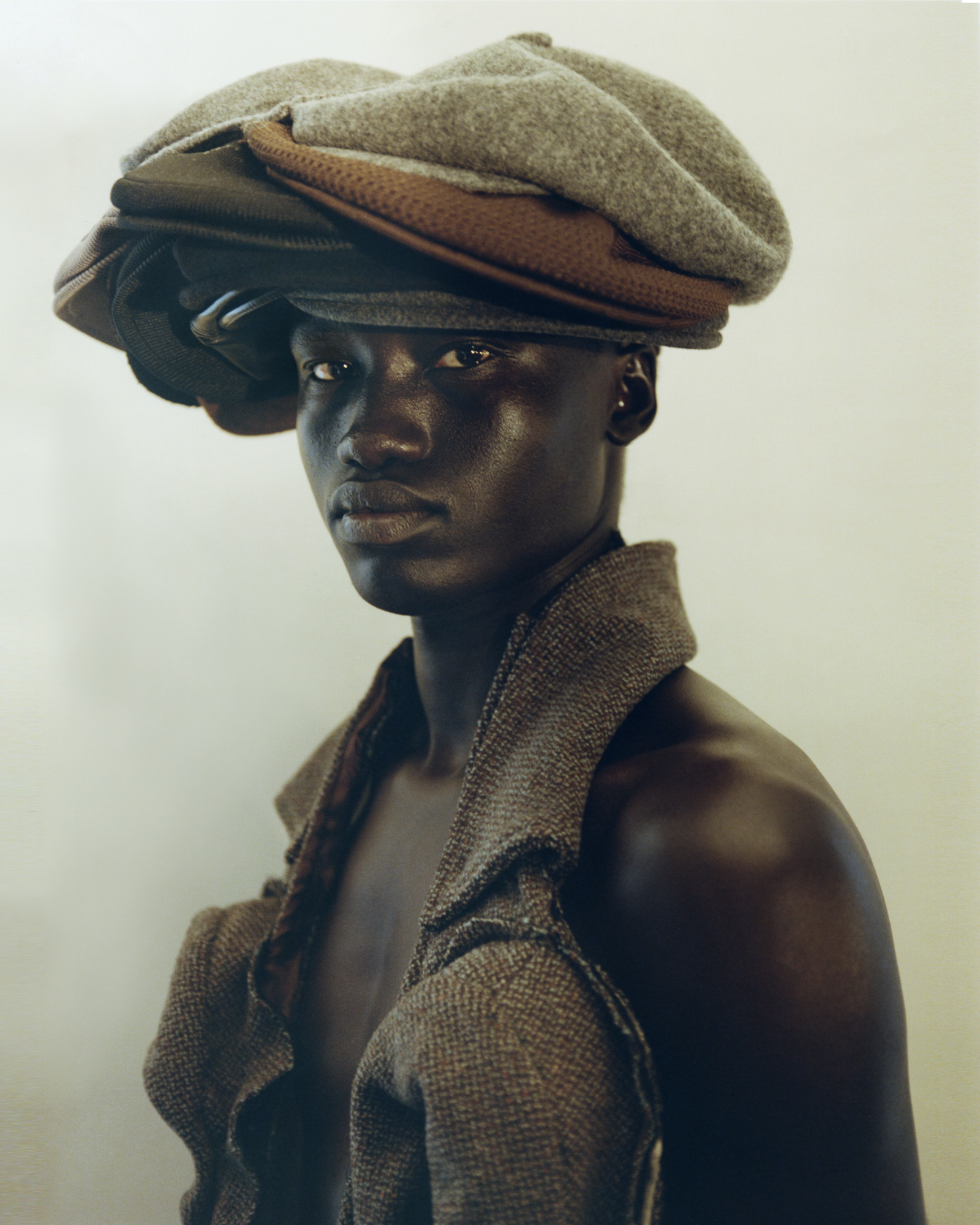
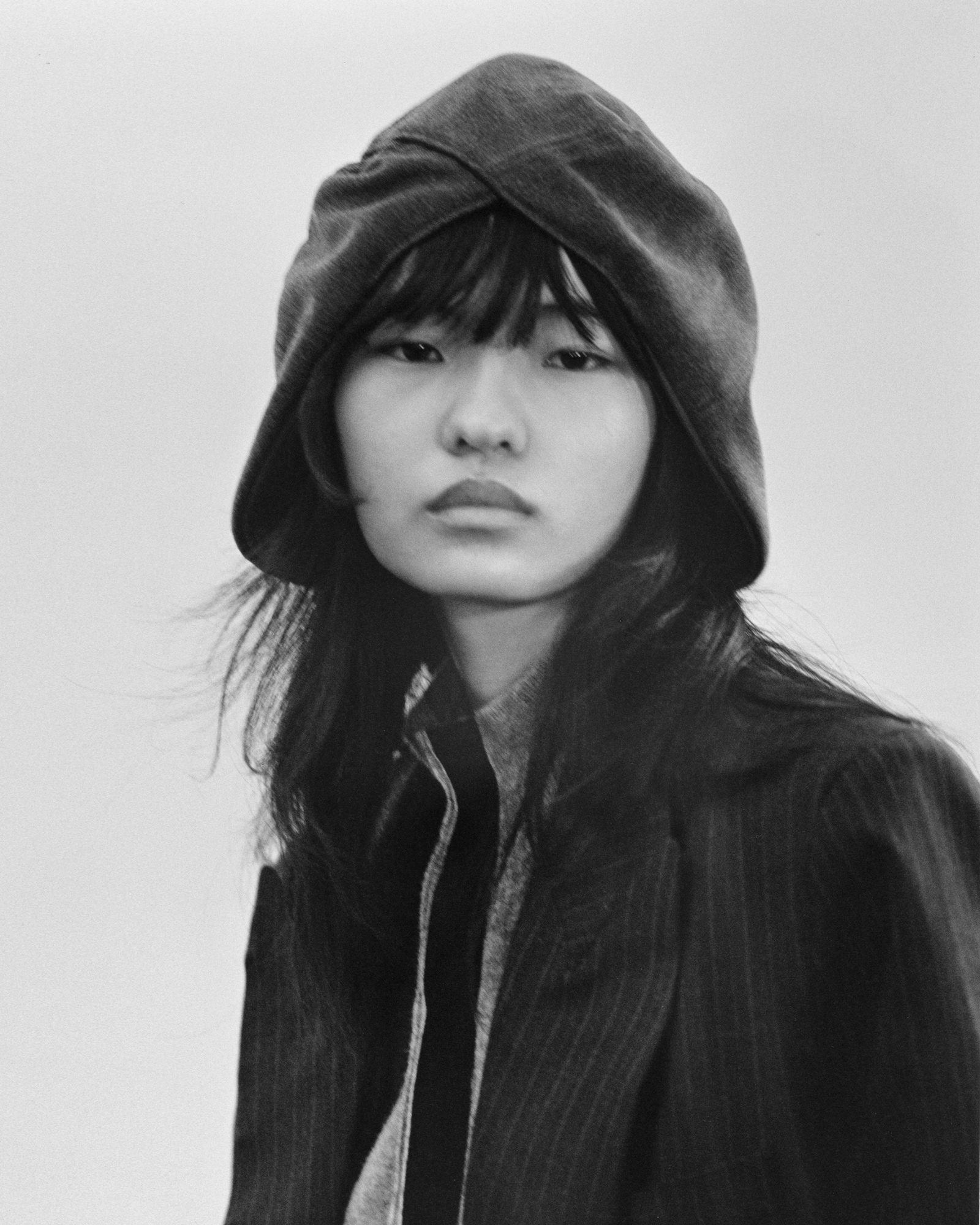
Nigerian English is threaded with archaic British phrasing like that—a linguistic residue of colonialism. “There’s a real obsession with old British architecture and dress,” Dumi says. “It’s quite romanticised.” So were period dramas, Catholic ritual, the choreography of Mass.
“I begged my mum to let me be an altar server,” she says, laughing. “I just wanted to wear the gown.” The garments mattered. The theatre mattered. “I loved the idea that you could step into another world.”
Before fashion, there was acting from the age of 7 through her teens, in and around St Albans. Costumes, staging, transformation. “It wasn’t just performing,” she says. “It was the whole environment.” When theatre fell away, visual art took its place. The Catholic Gothic resurfaced through skulls and shadowed figures. “That’s when I really went into my own head.” Dumi’s foundation year in art and design made use of that interiority. “Every day you could do whatever you wanted,” she says. Soldering. Woodwork. Life drawing. It was there she encountered Alexander McQueen, not as legend but as method. “I realised I was drawn to designers who built worlds,” she says. “The clothes were just one part of it.”
Studying menswear at the London College of Fashion, Dumi found the place to merge her many interests. Pattern-cutting was her forte. “I loved how you could mould a garment by your own logic,” she says. Internships at Sibling and Jamie Wei Huang in London, Studio Winkler in Berlin, and 3.1 Phillip Lim in New York sharpened that instinct. “While everything was amazing to experience, it also taught me how unstable this industry really is,” she reflects. “Anything can happen at any moment.”
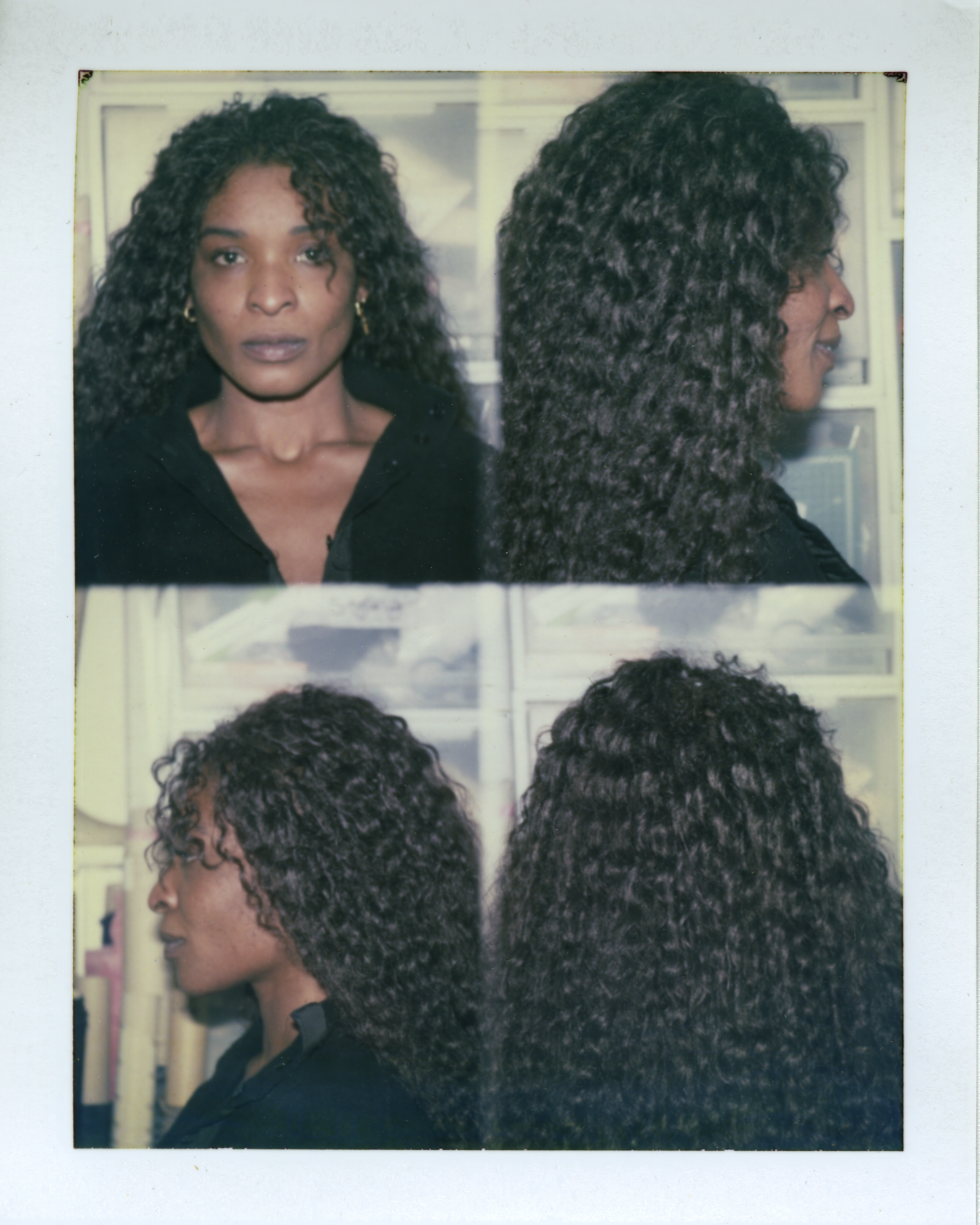
Then came Céline, under Phoebe Philo. “I didn’t get it until I worked there,” she admits. Working with the archive team, she handled garments and studied their construction. “The detail was insane.” She came to understand what consistency looks like over decades. “That’s when I became obsessed.”
When Central Saint Martins initially rejected her master’s application, she asked why. Fabio Piras gave her an answer she still carries: “Before you can know what you want, you have to know what you don’t want.” She went to Antwerp instead, interning with Ann Demeulemeester. A small team. Everything was drawn by hand. “That gave me confidence,” she says. “It confirmed I was on the right path.”
Dumi then reapplied to CSM and got in. A scholarship with Sarabande, courtesy of founder Trino Verkade and photographer Sølve Sundsbø, followed. “Thank God,” she says with a small exhale as she recalls her relief. “That covered my fees and my living expenses.” Covid fractured the experience, but that’s part of why it was so formative. “The tutors really understood me,” Dumi says. “They pushed me to be myself.” She’s precise about what she means: “There are expectations about what Black women should design. They encouraged me to ignore that completely.”
Her MA collection, Chimera, explored mutation. Ordinary garments evolved into unfamiliar forms. Sleeves appeared where they shouldn’t. This was the beginning of her now-signature horned tailoring. “It was the DNA of Torishéju before I even knew Torishéju would exist,” Dumi says. After graduating, she taught on the costume course at LCF, revisiting her love of theatre. In the evenings, she worked on a collection she couldn’t put down—Mami Wata. “I wasn’t thinking strategically,” she says. “I was just doing it because I liked it.”
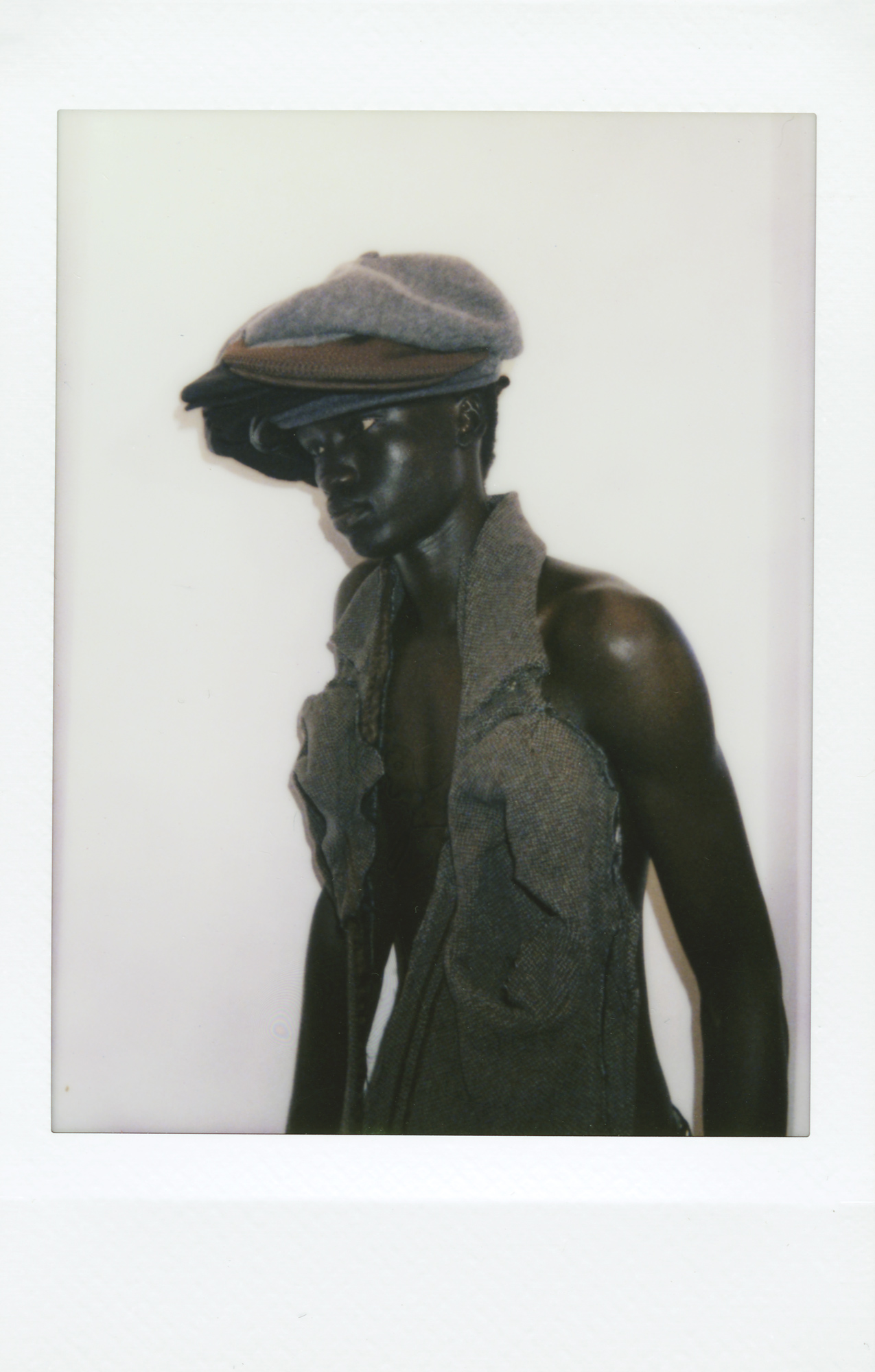
When she posted Mami Wata online, the response surprised her. Karefa-Johnson reached out, asking if a show was happening (and whether she could style it). Dumi said no; she didn’t have the money. What came next was unusual. Support without extraction. “It will always be a priority of mine to furnish Black women in fashion with resources and opportunity,” Karefa-Johnson says. “But that only works if the work can already support it. Activating my network, surrounding Torishéju with the right creatives, placing her clothes on Naomi Campbell and Kendall Jenner—that only mattered because the design was already there. This is what happens when generosity is directed toward artists who are ready.”
Lucien Pagès Communication soon joined pro bono. Advice came to show in Paris. “Paris will understand what you’re doing,” Dumi was told. Within months, the work moved from the internet to the runway. What began as an instinct became a debut—and then a business.
When I ask where her head is now, Dumi doesn’t hesitate. “I want to go to my mum’s,” she says. “Sit on the sofa Put EastEnders on. Eat sweet stuff. Just for a day.” She smiles. “And then the next day, game on.”
By the time we leave Jolene, her tea is cold and my ragù long gone. The afternoon has shifted. Some people build brands. Others cultivate gravity. Toju is doing the latter. Slowly. Carefully. On her own terms.
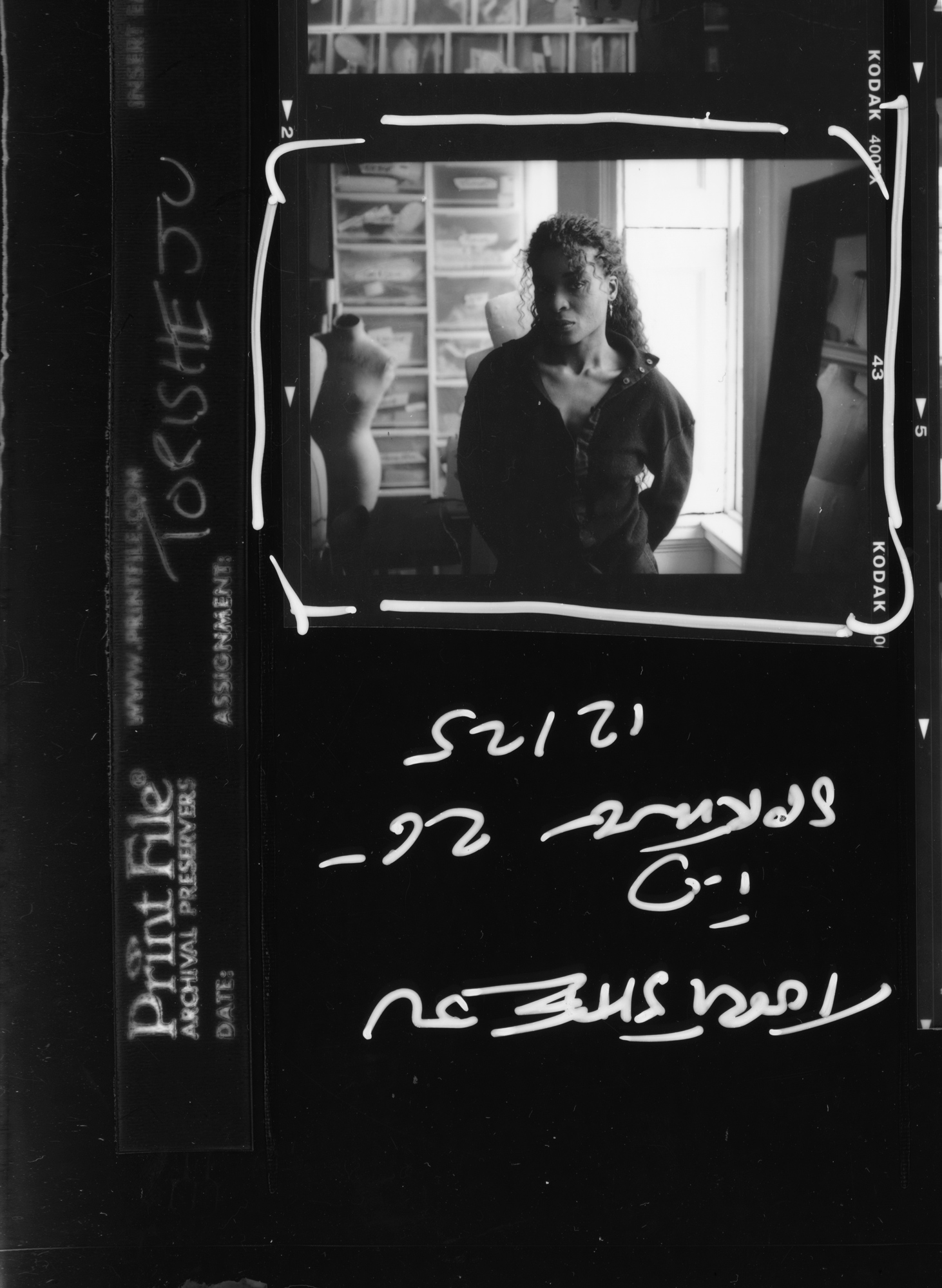
Hair SHUNSUKE MEGURO USING R+CO AT FUTURE REP
Casting Director ROXANE DIA
Models JUM KUOCHNIN AT MODELS1 & XINYE WANG AT PREMIER MODEL
Photography Assistant HEATHER LAWRENCE
Production THE MORRISON GROUP
Location SARABANDE FOUNDATION