Seeing used to mean believing. Now it means doubting whatever appears in front of you online. Every image is guilty until proven human. Has a bunny ever, in the recorded history of mammals, jumped on a trampoline? Is the Pope allowed to swag out in a Moncler puffer jacket? Does Hailey Bieber secretly have a hot brother?
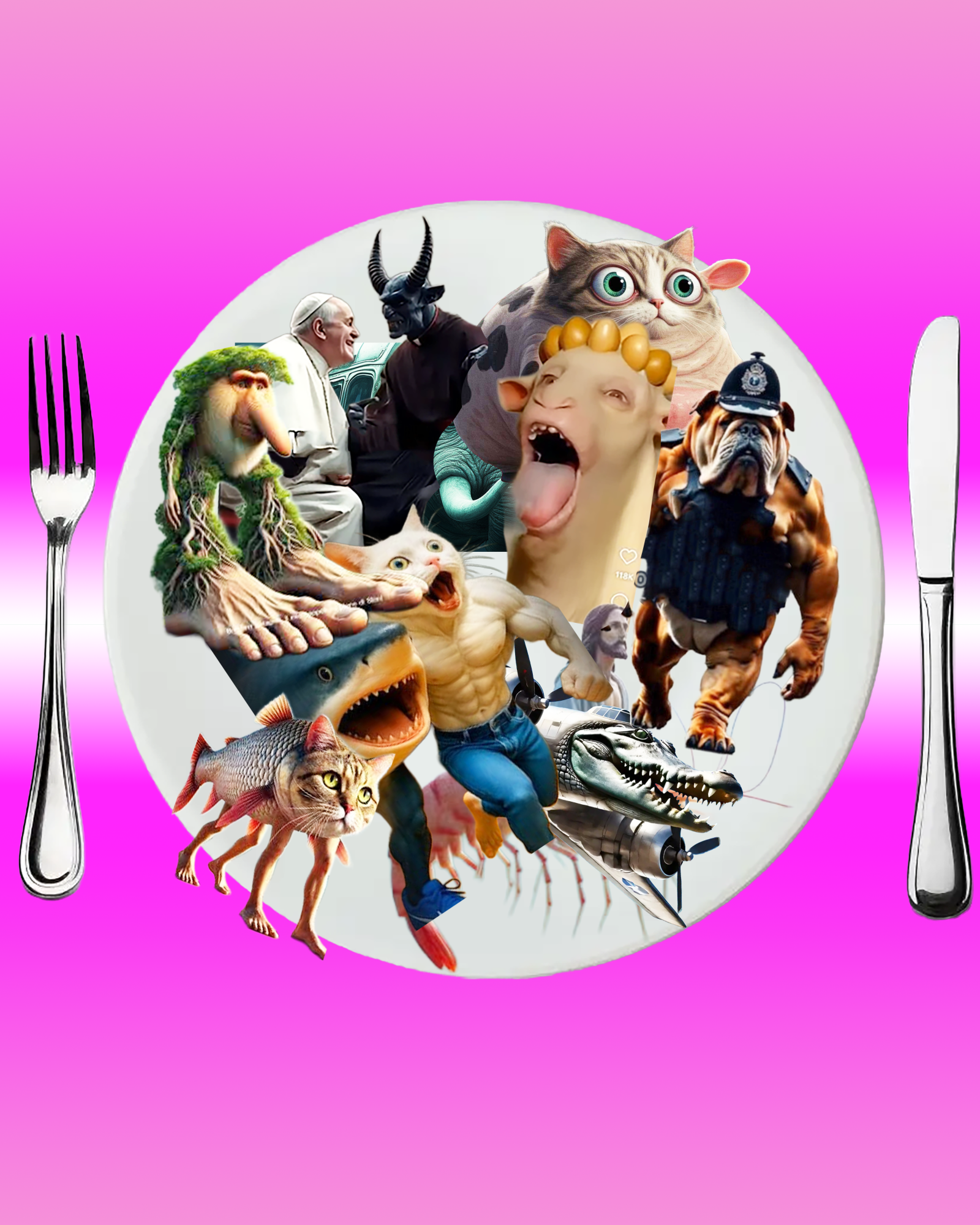
This year we tumbled headfirst into the slop-hole, a bottomless pit of mass-produced, low-effort algorithmic waste. Pumped out by generative tools like Midjourney and Sora, slop has seeped into every crushed corner of the internet, spawning thousands of images that arrive pre-stale: mushy, unformed, and shoveled into a digital trough for creatures without the privilege (or burden) of choosing their meals. Nearly one in ten of the fastest-growing YouTube channels now posts AI content exclusively. On TikTok, AI-generated clips routinely outperform human-made ones, proof that the algorithm can’t tell the difference and increasingly, neither can we. No surprise, then, that the Macquarie Dictionary crowned “AI slop” its word of the year, the institutional way of admitting we spent 2025 consuming aesthetic mush by the ladle.
The attraction of slop is that it’s the path of least psychological resistance. I know because I’m just as tangled as everyone else. I scroll slack-jawed, like a baby bird waiting for something pre-chewed to drop in. When the algorithm pushes a bowl toward me, I motorboat my face in it, grateful for the brief suspension of thought. In a world tilting under climate disasters, political chaos, and whatever fresh crisis the timeline serves before lunch, there’s something soothing about content that asks nothing of you, expects nothing from you, and reveals nothing about you either. Please, algorithm, won’t you serve me some more Chubby the Cat?
But underneath that private pleasure sits a very public panic. Each week, a new piece of viral slop sends the internet into a collective trust fall with no arms waiting at the bottom. The line between what was shaped by a human hand and what was excreted by a machine grows thinner by the day; we squint harder, understand less, and still can’t stop watching, which is maybe the part that scares us most.
What I can’t get over, though, is why machine-made imagery gives us cultural hives when so much human-made stuff already looks just as uncanny. Slop blends in because it resembles the culture we’d already built for ourselves. Long before AI entered the chat, years of overstimulation, dopamine flatlining, and compulsive self-curation had worn down the boundary between the real and the rendered. Labubu matcha Dubai chocolate, Lost Mary vapes, Skibidi Toilet, look-alike doppelgänger competitions: we’ve already normalized a culture that looks overtly synthetic. We lacquered our nerve endings in sugar, overriding their thresholds with a constant feed of hyper-saturated aesthetics until the surreal felt more familiar than the mundane. Along the way, we taught ourselves to crave that sensation, to chase the next pixelated jolt like overstimulated lab rats pressing the pleasure lever again and again.
Cultural critics have been diagnosing this drift for decades, tracing each new medium by the residue it leaves on our nervous systems. Every wave of mass entertainment arrives with the same accusation: pleasure delivered too fast, too easily, in doses that bypass thought and go straight for the bloodstream. Take David Foster Wallace, who argued that television wasn’t evil so much as “irresistible” because it offered “unearned, instant reward” and became dangerous precisely because it was “too good at providing what we wish for.” TV anticipated our desires before we could articulate them, spoon-feeding us pre-digested feelings until we became, in his words, “blank-eyed” spectators of our own attention. Decades earlier, Neil Postman had already warned that the real cultural threat wouldn’t be authoritarian control but entertainment so seamless, so sugary, that it would erode our appetite for depth. He imagined a society lulled not by fear but by pleasure, distracted into submission by a constant drip of stimulation.
These anxieties resurface every time a new medium appears. The printing press would rot the mind; novels would corrupt women; radio would radicalize children; television would liquefy attention; MTV would destroy literacy; video games would erode empathy; TikTok would reduce memory to a goldfish flicker. AI slop, though, feels like the final boss of that fear. It arrives at a velocity neither Wallace nor Postman could have imagined, hurling content at us faster than we can form the thought that we might want it. Their warnings, that mass media would dull our desire for depth and that frictionless entertainment would make us passive, now read like early symptoms of a cancer we only recognized after we were already deep into stage four.
Still, who can blame us for watching slop? Why wouldn’t we choose the warm, gelatinous tide over the cold clarities of complexity? The kinds of attention that actually stretch you feel impossible when most of us barely have the energy to reply to texts, let alone wrestle meaning from difficult art.
Here’s the thing: the forms of attention that make the world feel richer are almost always the ones we’ve written off as dry as hell. Take physics, a discipline full of invisible particles, imaginary numbers, and quantum realms no one can visualize. Not exactly a seductive pitch next to a feed engineered for brain-rot bliss. But as Carlo Rovelli writes in Seven Brief Lessons on Physics, “the beauty of the world is revealed to those who seek to understand it.” We must think the sky is boring, considering how often our necks are cranked down at our phones. But would you be so dismissive if you knew its blue comes from sunlight scattering off tiny air molecules? Or that sunsets turn red because the light has traveled so far through the atmosphere that only the longest wavelengths survive the journey?
The same goes for classical music. It’s not exactly something you’d pair with a split-screen of Subway Surfers and slime ASMR. And yet, when someone like Rosalía channels years of operatic training, classical discipline, and learning thirteen different languages into an album, doesn’t it sound so fucking good? Understanding animates the world. Slop flattens it, rewarding rapid consumption rather than gradual understanding. In a culture that worships ease, of course slop became the logical endpoint of desire. Attention is a muscle, and slop is the couch it’s sunk into.
If 2025 is the year of slop, then maybe 2026 can be the year we pick up a fork again and actually chew.
The Year We Became Slop
In an uncanny, over-filtered world where reality already feels AI-generated, slop is what our appetites keep defaulting to. But how do we stop eating it?
Loading